Hyperbaric Oxygen Therapy for Long Covid: What the Science Says — and What We Do at NEST
The state of the science in plain language, the NEST pilot protocol of 40 sessions up to 2.4 ATA, and the first results from participant Dianna.
If you are still stuck in fatigue, brain fog and pain months after a corona infection, you tend to hear the same advice: slow down, accept it, learn to live with it. Hyperbaric oxygen therapy for long covid tells a different story — one now supported by randomized research. In this article, you will read in plain language what the science does and does not know, what we do at NEST and with which equipment, and what our first pilot participant is experiencing after twenty sessions.
Do you recognise this — or do you guide someone with long covid? One message is enough to hear whether the pilot fits.
What long covid does to the body
In some people, corona does not clear after two weeks. The immune system stays dysregulated, low-grade inflammation persists, and the smallest blood vessels are damaged. The power plants of the cells — the mitochondria — also work less well.
That explains why the complaints hit hardest in organs that demand the most oxygen: the brain and the heart. Fatigue that sleep does not fix, brain fog, pain throughout the body, sensory overload and poor sleep are the result. If you want to read more about that mechanism: our article on neuroinflammation describes how smouldering inflammation in the brain keeps complaints going.
What hyperbaric oxygen therapy is
In a pressure chamber, you breathe nearly pure oxygen at a pressure higher than the outside air. Your blood therefore absorbs many times more oxygen — including the blood plasma, which normally carries hardly any.
Decades of research have established what repeated sessions do: they stimulate the formation of new blood vessels, activate stem cells, dampen inflammation and help mitochondria recover. Precisely the mechanisms that are disrupted in long covid. That is why researchers began testing this treatment in this patient group.
What the trials show
The strongest evidence comes from Israel. In 2022, the Sagol Center published a randomized trial in which half of the participants received forty real sessions and the other half a sham treatment in the same chamber — nobody knew which group they were in. After forty sessions, cognition, fatigue, sleep, pain and mood improved clearly more in the real treatment group. Brain scans also showed measurable changes in blood flow and brain tissue.
The 2024 follow-up strengthened the picture: more than a year after the last session, the improvements still held. Not a temporary boost, but a change that lasts. Further trials from the same group found improved heart function, and a 2024 systematic review adds up the balance: predominantly favourable, with the caveat that larger numbers are needed.
The Netherlands now has its own measurements too. In a prospective registry run by Eurocept Clinics, HGC Rijswijk and Erasmus MC, 232 long covid patients who underwent forty sessions between 2023 and 2024 were followed — on average already ill for twenty months. Three months after treatment, 56 to 63 percent reported clinically relevant quality-of-life improvement; the largest gains were cognitive: word-finding, memory and brain fog improved in two out of three people with severe complaints. Just as important is the flip side the registry exposed: 13 to 19 percent got worse. That led to stricter criteria — sufficient resilience beforehand and earlier termination upon deterioration. A randomized follow-up trial is being prepared in the Netherlands, with this registry as pilot data.
In the Netherlands too: 232 patients in a registry study
Closer to home, a Dutch registry study by Erasmus MC, Eurocept Clinics and the Hyperbaric Medical Centre (HGC) in Rijswijk has been running since 2023 — six of the nine Dutch hyperbaric chambers took part. 232 long covid patients who chose the treatment themselves, ill for a median of twenty months, were followed with validated questionnaires. Three months after completion, 56 percent reported a clinically relevant improvement in quality of life. The largest gains were in the cognitive domain: in roughly seven out of ten participants with severe word-finding problems, memory complaints or brain fog, severity decreased.
Just as important is what the study also found: in 13 percent of participants, complaints worsened. Particularly with pronounced exertion intolerance, the course can be too demanding. The Dutch centres adapted their protocol accordingly: anyone able to be upright and active for less than four hours a day is not currently eligible, and interim check-ups monitor the course. A controlled Dutch follow-up trial is in preparation, with this registry as pilot data.
And now the honest part
A Swedish trial published in 2025 — HOT-LoCO — tested a shortened course of ten sessions and found no difference from placebo at thirteen weeks. Both groups improved; the treatment group not more.
That sounds like bad news, but it is mainly a lesson about dose. The positive evidence comes from the full protocol of forty sessions; the negative result from a quarter of that. The trial also shows how real placebo effects are in this group — one more reason to only trust research with a control group.
The honest summary: hyperbaric oxygen therapy for long covid is promising, already widely used in Germany and also available in the Netherlands through Eurocept Clinics and HGC Rijswijk — but it is not yet proven standard care and is not reimbursed. Larger trials are running internationally; a randomized follow-up trial is being prepared in the Netherlands.
The NEST pilot: the full protocol, measured
That is exactly why we run it as a pilot — and exactly as in the research that did show an effect. We have also offered our chamber and guidance as a study site for the planned Dutch follow-up trial, under academic leadership: the real way forward runs through controlled research.
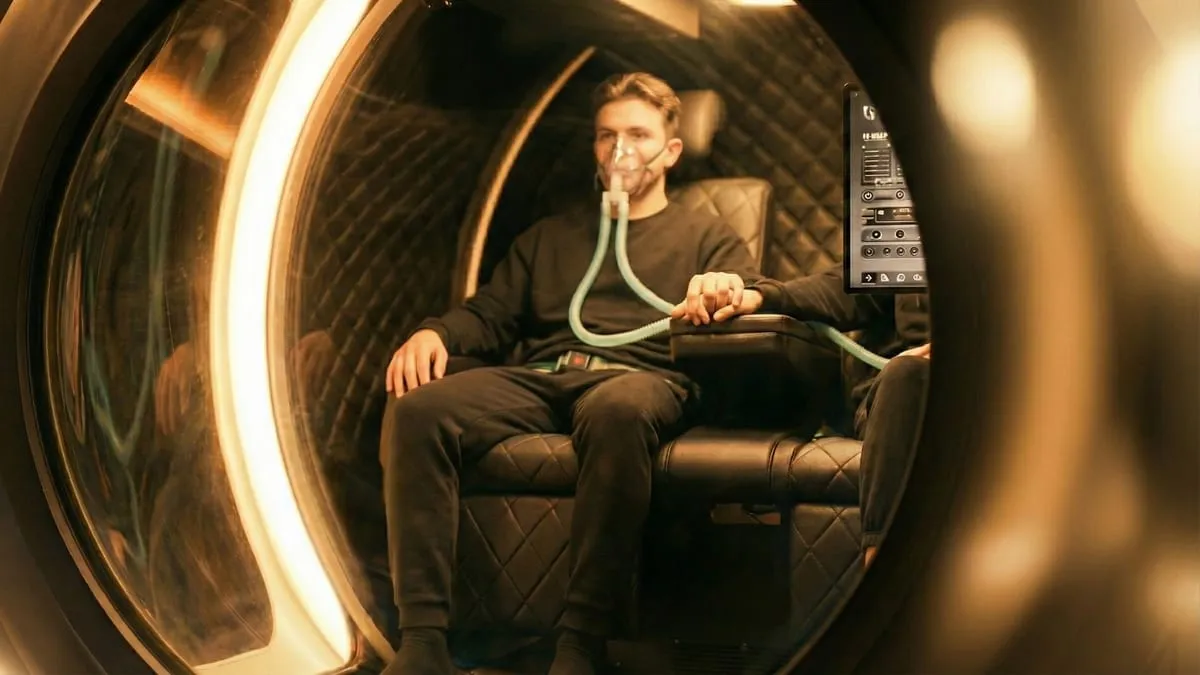
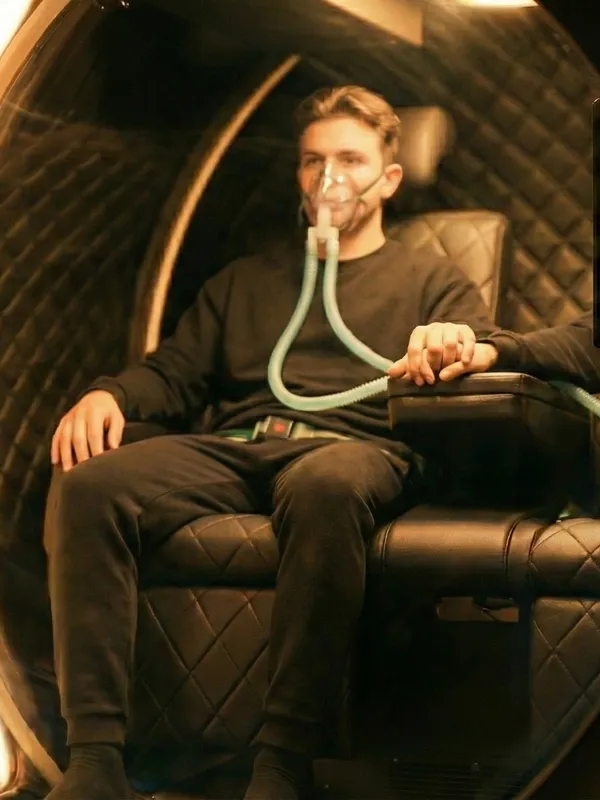
The chamber. You are treated in our hyperbaric chamber with a chamber pressure of up to 2.4 ATA — the same pressure range as in the clinical research. You breathe oxygen at approximately 95% through a mask or BIBS system, with fixed air breaks per the safety standard. The chamber is a duo setup: you enter together with a guide or a fellow participant.
The protocol. Forty sessions of sixty to ninety minutes, in a fixed rhythm of several sessions per week — the dose whose effect has been demonstrated.
Before and after every session. We place each session in a fixed frame: red light beforehand to prime cellular metabolism, and a rest block immediately after. Rest is a fixed part of our schedule — with long covid, that is not a luxury but a precondition. If you want to understand why light comes before oxygen: the mechanism is set out in our article on photobiomodulation.
Guidance and movement. Adapted physical training under guidance, built up at your own pace and within your energy limit — related to the progression in our burnout and neuro recovery programme. All in one quiet place in Luxwoude, Friesland.
Safety. An intake always takes place beforehand, in which we review your medical history and contraindications. This pilot is an addition to — never a replacement for — the care of your own physician. We also adopt two lessons from the Dutch registry in full: participation requires sufficient resilience — as a rule of thumb, You should be able to be upright and active for at least four hours a day — and if Your fatigue or symptom burden increases during the programme, we evaluate immediately and stop earlier if needed. Every five to ten sessions we review Your progress. From the Dutch registry study we adopt the resilience criterion: if you can be upright and active for less than four hours a day, this course is probably too demanding right now, and we first look together at building up. If your fatigue increases during the course, we discuss it immediately — stopping is always an option.
Dianna: halfway through
Four and a half years ago, Dianna fell ill. What began as a corona infection became long covid: pain throughout her body, persistent headaches, sleeplessness, no energy, sensory overload and a head that no longer worked the way it used to. She tried everything — from occupational therapy to sleep remedies. Real relief never came.
Dianna read about the research into hyperbaric oxygen therapy herself, and about its wide use in Germany. Through sport — which she had cautiously picked up again after years — she came into contact with our guide Nanouk, and so with NEST.
After twenty of forty sessions: she sleeps better, the pain in her body is gone, she is clearly improving cognitively, and she has considerably more energy. Her partner Jan sees it too: more stamina, less quickly overstimulated — and no more two days of recovery after a day with too many stimuli. Where recovering from simple things used to cost days, she can now cycle, walk, and even spend a weekend camping with her grandchild. She no longer uses sleep medication, and hardly any painkillers.
After twenty sessions I am already so much better — I am very curious what it will be like after forty. I know there are so many people living with long covid. It would be wonderful if my story reaches them, and they get the chance to try this too. — Dianna
For the record: this is the story of one participant, not a promise about your outcome. Noticeable change came gradually for her, around session fifteen. Precisely because results differ per person, we follow each participant individually in the pilot.
Joining the pilot
The pilot is open to people who still have complaints three months or longer after a corona infection: fatigue, brain fog, pain, sensory overload or sleep problems. Places are limited — the chamber runs in duo occupancy and the protocol requires forty sessions per participant.
Do you recognise yourself in this, or do you guide people with long covid as a GP, occupational physician or patient organisation? Get in touch — we will discuss without obligation whether the pilot fits your situation. Always discuss participation with your own physician as well. If you live elsewhere in the country: Eurocept Clinics and the HGC in Rijswijk also treat long covid, via referral by your physician.
The next step, without searching.
Experiences that fit this
"Ruim vier jaar post-covid en na tweeënhalve week zuurstofkamer al verbetering."
"Echt een aanrader voor ondernemers of mensen die even tot rust willen komen en weer helemaal willen opladen."
"Veertig sessies van negentig minuten in acht weken, met HRV, slaapscores en een wandeltest ernaast. Voor onze dochter is het verschil voelbaar."
Want to know what this means for you?
One message is enough. We schedule a fifteen-minute intake, no obligation, and tell you honestly whether NEST fits your question.
Scientific References
"In a randomized, sham-controlled trial, neurocognitive function, fatigue, sleep, pain and psychiatric symptoms improved in long covid patients after 40 HBOT sessions."
"At follow-up more than one year after the last session, improvements in quality of life, sleep, pain and psychiatric symptoms were maintained."
"A systematic review of HBOT for long covid reports predominantly favourable effects on fatigue and cognitive complaints, noting that larger trials are needed."
"In the Swedish HOT-LoCO trial, a shortened course of ten sessions produced no significant difference from placebo in physical functioning at thirteen weeks."
"In the Dutch prospective registry (232 patients, Eurocept Clinics and HGC Rijswijk, with Erasmus MC), 56–63% reported clinically relevant quality-of-life improvement three months after 40 HBOT sessions; 13–19% deteriorated, prompting stricter resilience criteria."
"In a Dutch prospective registry (232 patients, six hyperbaric centres), 56% reported a clinically relevant improvement in quality of life three months after HBOT; complaints worsened in 13%. The largest improvements were in the cognitive domain."