Hyperbaric Oxygen Therapy: The Complete Clinical Guide
Hyperbaric oxygen therapy increases dissolved oxygen by a factor of 10-15. From wound healing to neuroplasticity — the complete clinical guide.
You are looking into hyperbaric oxygen therapy. Likely you have heard that it accelerates wound healing or is used for decompression sickness. That is correct. But it is a fraction of the story. The scientific consensus is shifting: HBOT is a neurological intervention with applications ranging from burnout recovery to telomere lengthening.
This article describes the full spectrum — from the physical mechanism to the clinical protocols NEST employs for cognitive performance and cellular reconstruction.
What Is Hyperbaric Oxygen Therapy (HBOT)
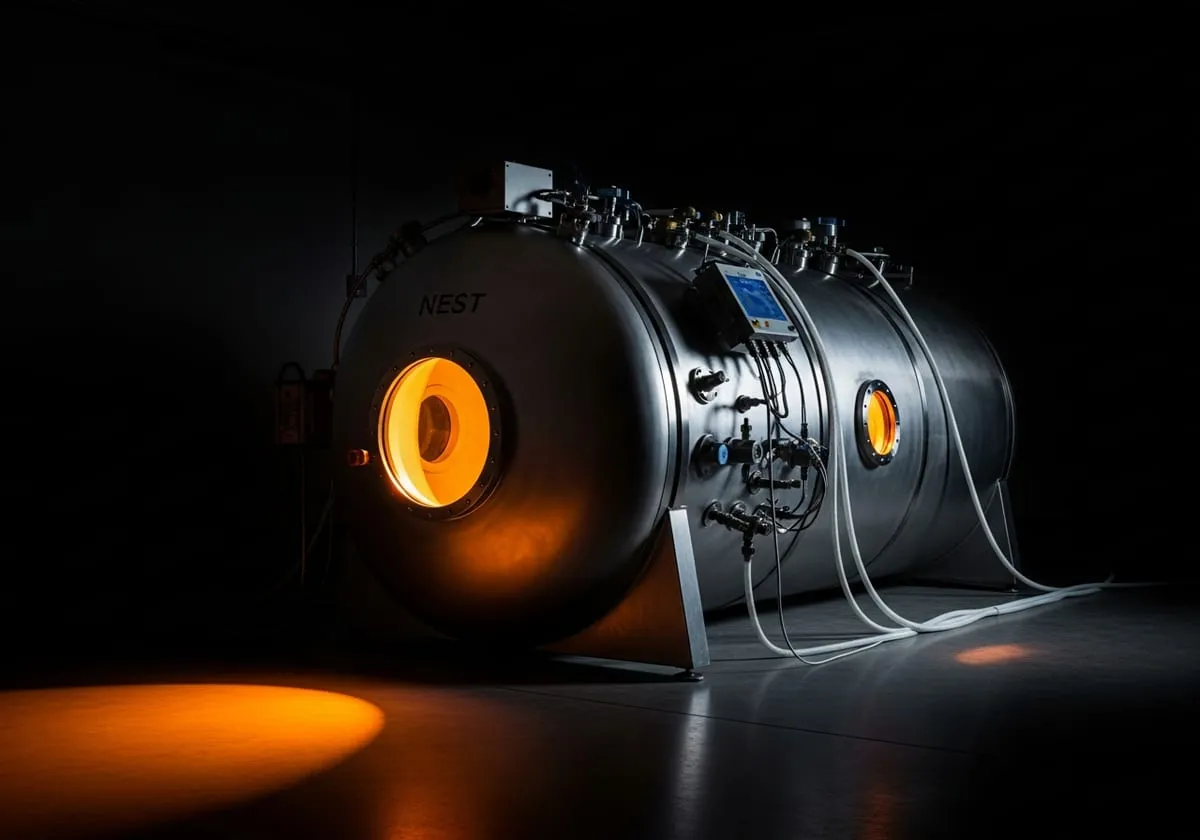
Hyperbaric oxygen therapy places a person in a pressure chamber at 1.5–2.4 ATA (atmospheres absolute) and has them breathe 100% oxygen. The mechanism follows Henry’s law: at increased pressure, more gas dissolves in liquid.
- Haemoglobin-bound oxygen
- Under normal conditions, haemoglobin transports 97-99% of all oxygen. This system is nearly saturated — breathing more delivers hardly any additional benefit.
- Dissolved oxygen in plasma
- At 2.0 ATA, dissolved oxygen in blood plasma rises by a factor of 10-15. This oxygen reaches tissues independently of haemoglobin, including areas with reduced perfusion.
The difference between a clinical hyperbaric chamber (hard shell, 2.0+ ATA, 100% O₂) and a mild hyperbaric bag (soft wall, 1.3 ATA, ambient air) is not gradual. It is categorical. At 1.3 ATA, the thresholds for neuroplasticity, stem cell proliferation, and angiogenesis are not reached.
At NEST, we operate a clinical hyperbaric chamber at 2.0 ATA with full medical monitoring.
HBOT Applications: From Wound Healing to Neuroplasticity
The clinical applications of oxygen therapy fall into three domains.
Domain 1: Wound healing and post-operative recovery. The original medical indication. At 2.0+ ATA, HBOT stimulates angiogenesis, fibroblast proliferation, and collagen synthesis. These indications are accessed through a GP or specialist, at a centre that meets the clinical definition. How to promote that healing yourself — from nutrition to oxygen — is covered in wound healing; for recovery after a procedure in recovering faster after surgery.
Domain 2: Neurological — cognition, burnout, TBI. At 2.0 ATA, increased cerebral oxygenation activates two cascades: BDNF upregulation for neuroplasticity and microglial modulation against neuroinflammation. The neurobiological mechanism of HBOT describes this cascade in detail.
Domain 3: Longevity — telomeres, stem cells, mitochondria. Research at Tel Aviv University demonstrated that 60 HBOT sessions lengthened telomeres by more than 20% and reduced senescent cells by 37% in healthy elderly participants.
Long covid: what the evidence says — and what we offer
Until August 2026 this section explained why we did not treat long covid. That position has been revised — not because the evidence suddenly became unequivocal, but because it turned out to be more nuanced than “one positive trial, one failed replication”.
The picture in brief. The randomized, sham-controlled trial with 73 patients showed improvement in cognition, fatigue, sleep and pain after 40 sessions at 2.0 ATA — and at follow-up more than a year later those improvements still held. The Swedish HOT-LoCO trial found no difference from placebo, but tested a shortened course of ten sessions: an indication that dose matters rather than a refutation of the protocol. And the Dutch prospective registry (232 patients, six centres, with Erasmus MC) saw clinically relevant improvement in 56% three months after the full course — but also deterioration in 13%, especially with pronounced exertion intolerance.
Those three findings together define what we offer: a pilot with the full protocol — 40 sessions up to 2.4 ATA in a duo setup, red light beforehand, a fixed rest block afterwards and an evaluation every five to ten sessions. And one hard gate, taken directly from the registry: if you cannot be upright and active for at least four hours a day, you do not start; if complaints increase during the course, we evaluate immediately and stop earlier if needed. The programme complements — never replaces — the care of your own physician.
The full state of the science, the protocol and the progress of participant Dianna are described in hyperbaric oxygen therapy for long covid; the practical framework is set out in the Long COVID Recovery Programme.
Hyperbaric Oxygen Therapy: Costs and Coverage
Neurological and longevity applications typically fall outside standard insurance coverage. Costs per session range from €150 to €300. A standard protocol comprises 20-40 sessions.
For professionals, a fiscally relevant route exists: cognitive maintenance via HBOT may qualify as a tax-deductible occupational health intervention. The fiscal analysis describes the legal framework.
HBOT at NEST: The Tri-Phasic Protocol
HBOT as a standalone session delivers suboptimal results. At NEST, we work according to the Tri-Phasic Model:
| Phase | Intervention | Function |
|---|---|---|
| 1. Priming | Red light therapy (660/850nm PBM) | Photodissociation of NO from cytochrome c oxidase. Opens the mitochondrial electron transport chain. |
| 2. Potentiation | Hyperbaric oxygen therapy (2.0 ATA) | The now-opened mitochondria receive the elevated oxygen. ATP production rises 30-40% above standalone HBOT. |
| 3. Integration | Vagus nerve therapy (Satori VAT) | Parasympathetic activation anchors neuroplastic changes. |
The Burnout Neuro-Recovery Retreat integrates this complete Tri-Phasic Protocol. For post-operative recovery, the Operative Recovery Programme offers a specialised protocol at 2.4 ATA. The Neuro-Cognitive Performance Retreat focuses specifically on cognitive optimisation for professionals.
Hyperbaric oxygen therapy is not the future. It is now. The data are published. The chamber is ready. The only variable is the protocol around it — and that protocol determines whether you utilise 60% or 100% of the therapeutic potential.
Which pattern do you recognise?
Two short questions, three clear options. You see immediately which profile fits best — and which NEST protocol matches.
Which pattern do you recognise most strongly?
The next step, without searching.

Experiences that fit this
"Echt een aanrader voor ondernemers of mensen die even tot rust willen komen en weer helemaal willen opladen."
"Ondanks mijn zware werkweekend ga ik hier uitgerust vandaan."
"Een wereld waarbij de tijd stilstaat en er tegelijkertijd de mogelijkheid is om kennis te maken met technologie die zijn tijd ver vooruit is."
Want to know what this means for you?
One message is enough. We schedule a fifteen-minute intake, no obligation, and tell you honestly whether NEST fits your question.
Scientific References
"Repeated hyperbaric oxygen exposure lengthens telomeres by more than 20% and reduces senescent cells by 37% in healthy elderly."
"In a randomized, sham-controlled trial, neurocognitive function, fatigue, sleep, pain and psychiatric symptoms improved in long covid patients after 40 HBOT sessions."
"In the Swedish HOT-LoCO trial, a shortened course of ten sessions produced no significant difference from placebo in physical functioning at thirteen weeks."
"In a Dutch prospective registry (232 patients, six hyperbaric centres), 56% reported a clinically relevant improvement in quality of life three months after HBOT; complaints worsened in 13%."