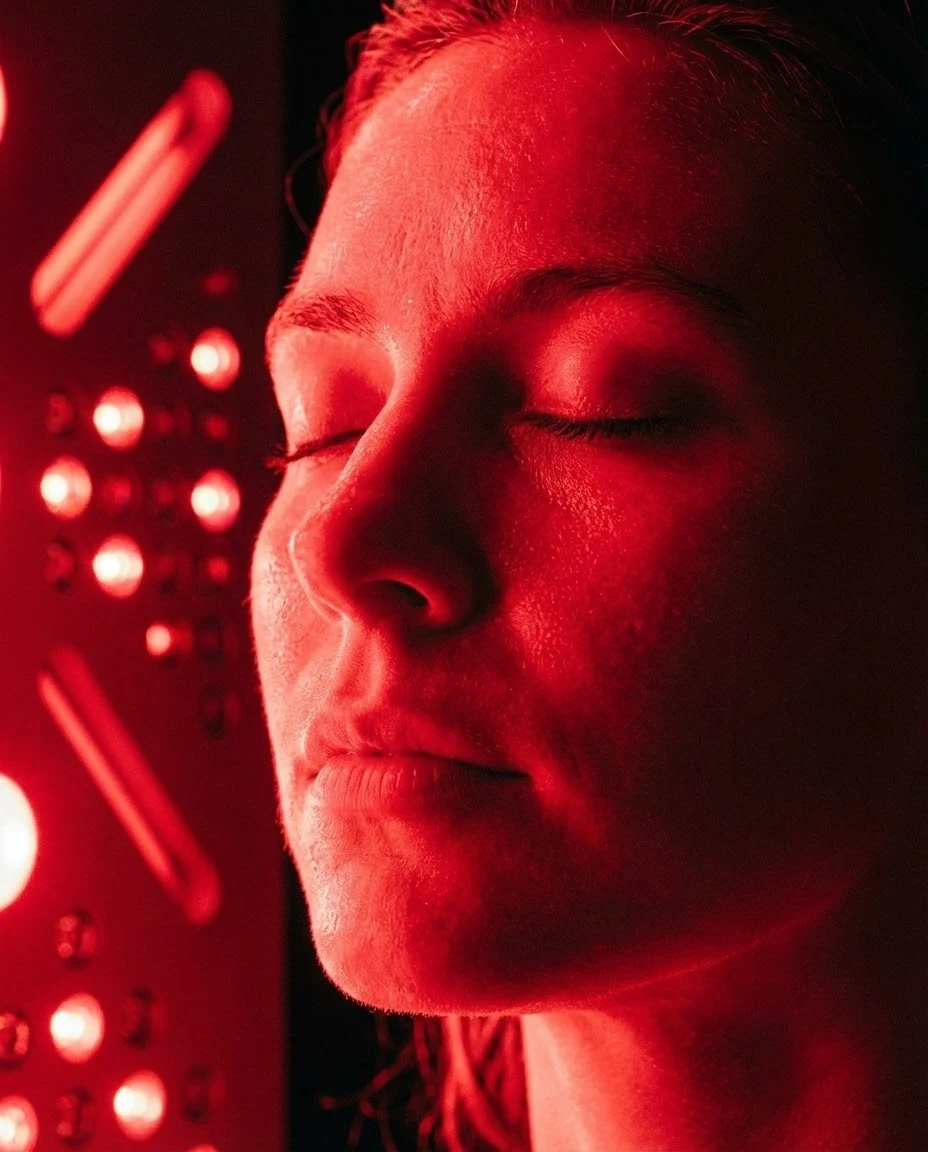
Full-Body Red Light (PBM)
Mitochondrial Activation & Skin
Photosynthesis for human cells. Recharge your internal battery.
Why light recharges the cell where rest fails to fill the battery.
Bio-Engineering for Your Cells
Your reflection reveals the toll of years of intense professional pressure: skin losing its vitality and energy levels that collapse midway through the day. Cosmetic creams and caffeine work only at the surface.
Red light therapy at NEST is not a beauty treatment; it is an energy source. It is photosynthesis for the human cell, engineered to restart the engine of your body—the mitochondria.
The Mechanism: ATP Synthesis
Specific light wavelengths (660nm and 850nm) penetrate deep into the cell. They decouple nitric oxide (NO) from the enzyme Cytochrome C Oxidase. This allows oxygen to bind once more and the cell resumes production of ATP (Adenosine Triphosphate). This is literally recharging your biological battery. For post-operative clients, this means faster cell division and reduced scar tissue.
The NEST Difference
The market is flooded with weak home panels. NEST Wellness works exclusively with Ultron-class full-body systems. These deliver the clinically required irradiance (>100mW/cm²) to reach not only the skin, but also deeper tissues and muscles.
From sluggish mitochondria to full ATP output — in a single session.
Mitochondrion stalling
Too little light, too little fuel. The cellular power plant runs slow — ATP output drops below the line.
Mitochondrion recharged
Red and near-infrared light sets the electron chain moving again — ATP filled to the brim.
Explosive ATP Production
Systemic Anti-Inflammation
Accelerated Wound Healing
Collagen Synthesis
Experiences with Full-Body Red Light (PBM)
"Wellness next level. De combinatie van Hyperbare Zuurstof, ReLounge ZeroG en EMR-TEK lichttherapie is een krachtige mix."
"Afgesloten met EMR-TEK lichttherapie. Alsof m'n batterij weer op 100% stond!"
"Full-body redlight, een akoestische massage op celniveau en de hyperbare zuurstoftherapie. Na afloop een energiek en ontspannen gevoel."
Photosensitising medication · Active carcinomas (direct irradiation) · Pregnancy (abdomen, pelvis and lumbar region; full-body not advised)
Start the intake.
Start your intake via WhatsApp →Within a protocol or combination the price is lower. We compose your protocol together during the intake.
± 15 min, no obligation
For those not yet convinced — the literature, and where it leads.
Photobiomodulation works primarily through photon absorption by cytochrome c oxidase in the mitochondrial respiratory chain, increasing ATP production.
Treatment with polychromatic light (611-650nm and 570-850nm) induces significant improvement in skin complexion, collagen density and roughness, measured via ultrasonography.
Photobiomodulation activates cytochrome c oxidase in mitochondria, increases ATP production, and modulates reactive oxygen species and nitric oxide.
Red-to-near-infrared light modulates oxygen consumption of isolated Cytochrome C Oxidase in the presence of a nitric oxide donor, supporting the photodissociation hypothesis.