Red Light Therapy Face: Clinical PBM vs. Consumer Masks — What Research Shows
Red light therapy for the face clinically explained. Collagen, acne, anti-aging — why dosage is decisive and consumer masks fall short.
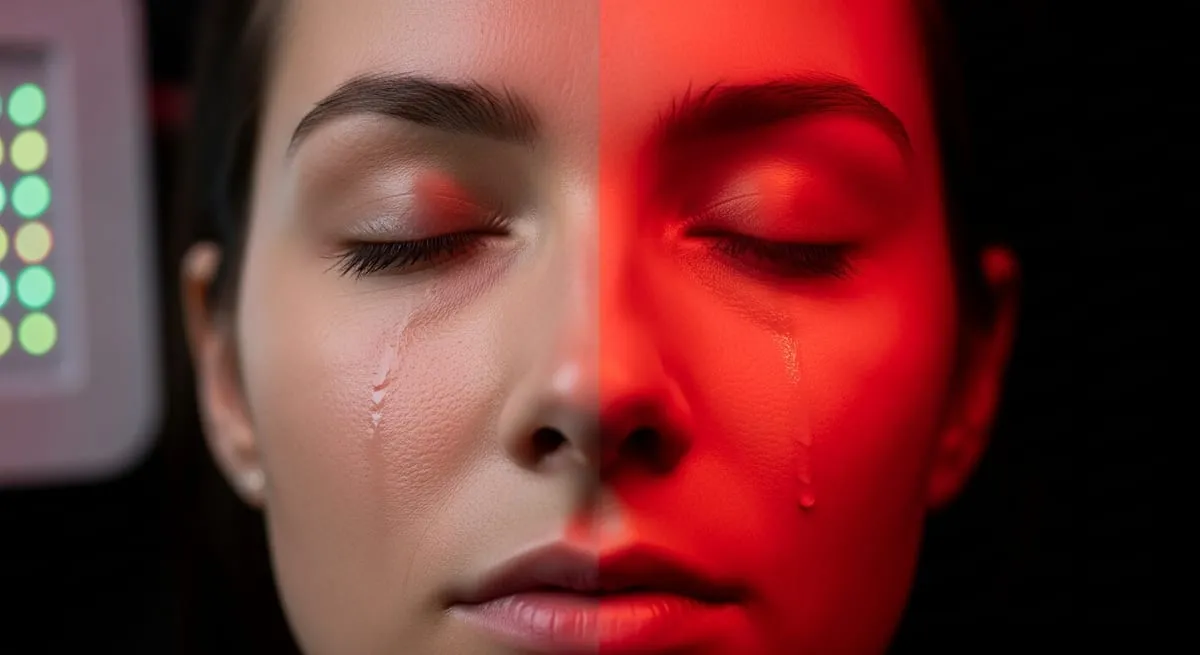
Red light therapy for the face is everywhere: Instagram ads featuring LED masks for €49, beauty bloggers promising “anti-aging in 10 minutes,” and Amazon pages filled with five-star reviews. What nobody mentions is the dosage difference that separates a cosmetic ritual from a clinical intervention. The science behind photobiomodulation (PBM) is solid — but the translation into consumer devices loses the effective mechanism along the way.
How Red Light Therapy Works on Facial Skin
The biological effect of red light therapy on the face rests on a specific photochemical principle. Photons at a wavelength of 660nm are absorbed by cytochrome c oxidase (CCO) — the terminal enzyme in the mitochondrial electron transport chain of dermal cells. This absorption increases electron transfer and thereby the production of adenosine triphosphate (ATP), the primary energy carrier of every cell.
- 660nm — Epidermis and superficial dermis
- Red light at 660nm penetrates 1-2mm into the skin. It activates fibroblasts — the cells that produce collagen. The resulting increase in ATP stimulates synthesis of collagen type I and type III, the two structural proteins that determine the firmness and elasticity of facial skin.
- 850nm — Deep dermis and subcutaneous tissue
- Near-infrared at 850nm penetrates 3-5mm. At this depth, it reaches the microvasculature and influences systemic processes: reduction of reactive oxygen species (ROS), modulation of TGF-β signaling, and improvement of local microcirculation.
The mechanism is not cosmetic. It is bioenergetic. When a cell produces more ATP, it can better execute its repair and synthesis functions. For facial skin, this means: more collagen production, faster cell renewal, and reduced inflammatory markers. This is not marketing — this is mitochondrial biology, documented in peer-reviewed research.
Clinical Results: What Research Shows for Skin and Face
The clinical evidence for red light therapy on the face concentrates on three application areas, each with specific dosimetric parameters.
Collagen and anti-aging. Wunsch and Matuschka (2014) conducted a randomized, controlled trial with 136 subjects. Treatment with polychromatic light (611-650nm and 570-850nm) over 30 sessions resulted in significant improvement of skin complexion, collagen density, and surface roughness, measured via ultrasonography. The control group showed no change. The effective dose: 46-79 J/cm² cumulative over the treatment protocol.
Acne and inflammation. Papageorgiou et al. documented that the combination of blue (415nm) and red (660nm) light significantly reduced inflammatory acne lesions after 12 weeks of treatment. The mechanism: blue light eliminates Propionibacterium acnes via porphyrin-induced phototoxicity, while red light modulates the dermal inflammatory response through reduction of pro-inflammatory cytokines.
Wound healing and post-inflammatory hyperpigmentation. PBM accelerates wound healing via two parallel pathways: fibroblast proliferation (direct collagen production) and angiogenesis (new blood vessel formation that improves nutrient supply). For post-inflammatory hyperpigmentation — the dark spots that remain after acne or injury — research shows that PBM normalizes melanocyte activity when applied at the correct dosage.
The consistent finding across all applications: dosage is decisive. Not the color of the light, not the duration of the session, but the energy density in joules per square centimeter (J/cm²) determines whether the treatment is biologically effective.
Consumer Masks vs. Clinical Photobiomodulation: The Dosage Gap
This is where the problem with Your Amazon LED mask begins.
The photobiomodulation literature documents a biphasic dose response — the Arndt-Schulz curve. Low doses stimulate biological processes. Excessive doses inhibit them. The therapeutic window for dermal collagen induction sits at a minimum energy density of 4 J/cm² per session, with an optimum between 10-30 J/cm² depending on tissue and indication.
| Parameter | Consumer Mask | Clinical PBM (NEST) |
|---|---|---|
| Power density | 5-20 mW/cm² | 150+ mW/cm² |
| Session duration | 10-20 min | 15-20 min |
| Energy density | 3-6 J/cm² | 20-30 J/cm² |
| Spectral precision | Broad, unspecified | 660nm ± 5nm / 850nm ± 10nm |
The difference amounts to a factor of 5 to 10 in energy density. Many consumer masks sit just at or below the biological threshold — they deliver barely enough energy to produce a minimal cellular effect, but insufficient for clinically significant collagen synthesis. It is the difference between a therapeutic dose and a homeopathic dilution.
Additionally, consumer devices lack spectral precision. The two absorption peaks of CCO lie at 660nm and 850nm. Many LED masks use broad spectral bands that only partially overlap these peaks, rendering a significant portion of emitted photons biologically inert.
Full-Body PBM at NEST: More Than Just Facial Treatment
The fundamental misconception in the consumer market is that red light therapy is a local treatment. You buy a face mask for Your face, a panel for Your back, a device for Your knee. Each treats an isolated surface area.
At NEST, the approach is opposite. Clinical photobiomodulation is administered as a full-body protocol — and Your face receives the clinical dose as an integral component. No separate device, no subtherapeutic power density, no guesswork about dosage.
The advantage of this systemic approach extends beyond local skin improvement. With full-body irradiation the whole skin is treated rather than just the face, in a single 20-minute session. What that does elsewhere in the body we leave unstated here — we cannot make claims about it that we can also substantiate.
The combination with hyperbaric oxygen therapy amplifies this effect. HBOT increases oxygen availability in all tissues, including the dermis. Fibroblasts are oxygen-dependent for collagen synthesis — more available oxygen means more substrate for the collagen hydroxylation that PBM initiates. The two interventions are synergistic at the mitochondrial level: PBM activates the electron transport chain, HBOT delivers the terminal electron acceptor (oxygen) in excess.
The Bio-Balance Membership at NEST integrates these protocols into a structural maintenance program. Not as an incidental treatment, but as periodic mitochondrial optimization — comparable to maintaining a high-performance system. Your skin is a visible biomarker of Your mitochondrial health. When the system functions, the result is not only measurable via ultrasonography but visible in the mirror.
Red light therapy for the face works — that is not in dispute. The question is whether Your device reaches the threshold. A consumer mask delivers a fraction of the clinical dose. Clinical photobiomodulation delivers the protocol that science supports. The difference is not subjective. The difference is a factor of 10 in energy density — and that difference determines whether Your fibroblasts actually produce collagen or merely leave a warm sensation. The Bio-Balance Membership begins where Your consumer mask ends.
The next step, without searching.
Experiences that fit this
"Afgesloten met EMR-TEK lichttherapie. Alsof m'n batterij weer op 100% stond!"
"Echt een aanrader voor ondernemers of mensen die even tot rust willen komen en weer helemaal willen opladen."
"Veertig sessies van negentig minuten in acht weken, met HRV, slaapscores en een wandeltest ernaast. Voor onze dochter is het verschil voelbaar."
Want to know what this means for you?
One message is enough. We schedule a fifteen-minute intake, no obligation, and tell you honestly whether NEST fits your question.
Scientific References
"Treatment with polychromatic light (611-650nm and 570-850nm) induces significant improvement in skin complexion, collagen density and roughness, measured via ultrasonography."
"Combination of blue (415nm) and red (660nm) light is effective in treating mild to moderate acne vulgaris, with significant reduction in inflammatory lesions."
"Photobiomodulation exhibits a biphasic dose response: low doses stimulate biological processes while high doses inhibit them, with optimal parameters between 1-4 J/cm² for tissue repair."