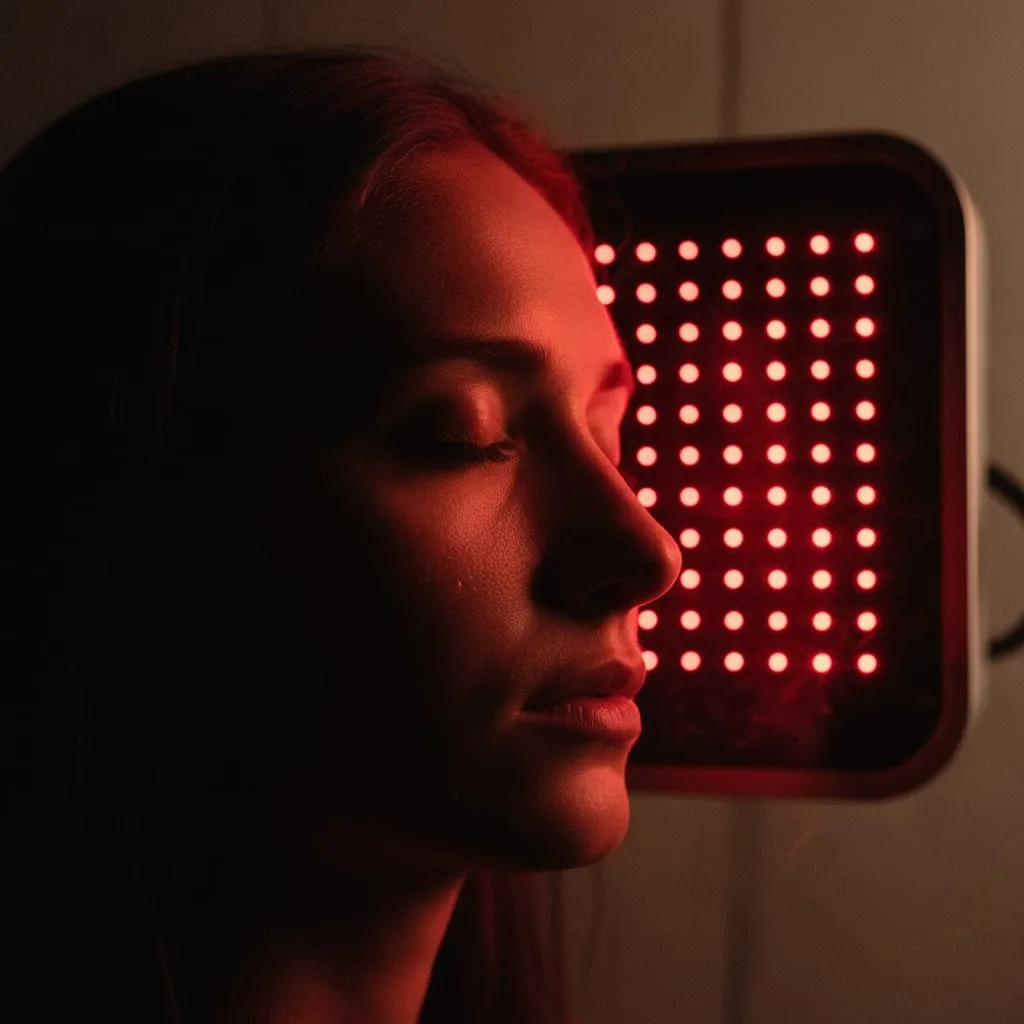
Red Light Therapy Effects: Clinical Photobiomodulation at 660 and 850nm
What does red light therapy actually do? Clinical photobiomodulation at 660/850nm increases mitochondrial ATP production. Evidence-based results.
The human mitochondrion is the powerhouse of our cells — yet under chronic stress, metabolic strain, and degenerative processes, it loses efficiency. Red light therapy’s effects rest on an elegant biological principle: stimulation of the mitochondrial respiratory chain through specific light wavelengths. Unlike what the commercial consumer market suggests, true photobiomodulation (PBM) is a highly specific medical intervention grounded in biophysical first principles.
NEST applies clinical photobiomodulation in standardized protocols — not as a lifestyle add-on, but as a precisely dosed intervention for mitochondrial restoration. This article examines the scientific mechanisms, distinguishes between effective and ineffective devices, and demonstrates how whole-body PBM combined with hyperbaric oxygen therapy produces a multiplicative biological effect.
What is red light therapy and how does it work at the cellular level
Red light therapy’s effects rest on a fundamental insight in photobiology: photons in the spectral range of 600 to 1100 nanometers are absorbed by a specific enzyme complex in the inner mitochondrial membrane — Complex IV, also known as cytochrome c oxidase (CCO).
- Cytochrome c oxidase (CCO)
- The terminal enzyme of the mitochondrial electron transport chain, containing two copper centers and two heme-a groups. These cofactors absorb photons in the red (660nm) and near-infrared range (850nm), optimizing electron transfer and ATP production.
- Photobiomodulation (PBM)
- A medical application of non-ionizing light (typically 600-1100nm) that improves mitochondrial function without causing thermal damage. The effect is dose-dependent and wavelength-specific.
- Mitochondrial ATP synthase
- The enzyme that harnesses the proton gradient across the mitochondrial inner membrane to produce adenosine triphosphate (ATP) — the primary energy currency of all cellular processes.
The mechanics are precise: when photons strike CCO, electrons in the copper centers become excited. This increases the mitochondrial membrane potential, which in turn drives ATP synthase. The result is enhanced oxidative phosphorylation — in other words, more biological energy per mitochondrion.
The two spectral windows have different penetration depths and absorption profiles. 660 nanometers (deep red) is absorbed particularly efficiently by superficial tissues, 850 nanometers (near-infrared) penetrates deeper into muscle and organ tissue. For maximum effect, the combination of both wavelengths is necessary — not a single wavelength alone.
This is the fundamental difference between scientific photobiomodulation and the countless consumer products that emit a single wavelength with wholly insufficient energy densities. Hamblin and colleagues have extensively documented in reviews that CCO absorption at these two wavelengths is maximal, while other areas of the visible spectrum are considerably less effective.
Near-infrared versus classical red light: The decisive difference
The distinction between true clinical photobiomodulation and consumer devices lies not in aesthetics or branding, but in three critical parameters: wavelength precision, power density, and energy density per session.
Classical red light in the range of 630-680nm offers the advantage of superficial penetration and efficient CCO activation in skin and mucous membranes. Near-infrared light (800-900nm) penetrates biological tissue orders of magnitude more effectively and reaches deep muscle, bone, and internal organs.
A clinical example for clarity: a consumer red light panel with 50 watts total power applied at 30cm distance typically delivers 20-50 mW/cm² at the skin surface. A true medical PBM device delivers 100-200 mW/cm² or higher. Energy density — measured in joules per square centimeter (J/cm²) — is the decisive factor for biological effects.
- Energy density (Fluence)
- Measured in joules per square centimeter (J/cm²). Therapeutic range typically lies between 1-4 J/cm² for superficial tissue, 6-30 J/cm² for deeper structures. Consumer devices often achieve only 0.1-0.5 J/cm² per session.
- Power density (Irradiance)
- Measured in milliwatts per square centimeter (mW/cm²). This determines the speed at which photons are absorbed. Optimal therapeutic power density lies between 50-200 mW/cm².
- Spectral window (Optical Window)
- The biologically optimal wavelength range of approximately 600-1000nm in which light penetrates sufficiently deep and is efficiently absorbed by chromophores such as cytochrome c oxidase.
The consequences of these differences are measurable. Studies show that devices with insufficient energy density — whether through too-brief application, inadequate power, or excessive distance — achieve no consistent biological effects. Consumer devices are typically positioned in the subtherapeutic range.
Clinical PBM systems, by contrast, are calibrated, dosed, and validated. They reproducibly deliver the necessary energy density over defined periods. This is the difference between product marketing and medical intervention.
Red light therapy for face and skin: What research shows
The dermal application of red light therapy is most thoroughly studied and shows the most consistent results. The mechanism is two-fold: on one hand, direct mitochondrial stimulation of fibroblasts; on the other, secondary effects through reduced inflammation and apoptosis protection.
Fibroblasts — the cells responsible for collagen and elastin synthesis — respond particularly sensitively to 660nm photons. Multiple randomized controlled trials demonstrate increased collagen synthesis and accelerated dermal wound repair after 2-4 weeks of standardized PBM treatment.
A 2018 systematic review scanned 30 years of clinical data and concluded that photobiomodulation significantly accelerates wound repair speed at optimal parameters (1-4 J/cm²). This is explained by multiple biological mechanisms: increased angiogenesis (new blood vessel formation), elevated fibroblast proliferation, and reduced inflammatory markers such as Tumor Necrosis Factor (TNF-α).
Collagen synthesis is stimulated by PBM through multiple signaling pathways. The enzyme prolyl hydroxylase, required for proline hydroxylation — a critical step in collagen stabilization — is activated by elevated mitochondrial ATP. Simultaneously, through increased ATP availability, the expression of collagen I and collagen III is upregulated.
For the face specifically, clinical observations show improvements in skin elasticity, reduction of superficial fine lines, and more uniform pigmentation after 12-16 weeks of regular treatment with 660nm at therapeutic density. This is not a short-term cosmetic effect, but structural remodeling of dermal collagen.
The anti-inflammatory component is particularly relevant for patients with acne or inflammatory skin disease. Red light therapy reduces the production of reactive oxygen species (ROS) in mitochondria and simultaneously activates the body’s own antioxidant systems such as superoxide dismutase (SOD). This leads to normalization of inflammation without systemic side effects.
Whole-body photobiomodulation: The clinical NEST protocol
NEST’s approach to photobiomodulation differs fundamentally from local or superficial applications. The protocol uses a whole-body PBM device with simultaneous application of 660nm and 850nm to all major body areas — torso, limbs, head, and neck — in a defined 20-minute session.
The biological rationale is two-fold. First, whole-body application targets systemic mitochondrial density, not merely local effects. The mitochondrion is the same everywhere, and systemic improvement in ATP production has consequences for all energy-dependent processes: neurological plasticity, cardiovascular function, immune tolerance, and cellular repair mechanisms.
Second, photobiomodulation at NEST is standardly combined with hyperbaric oxygen therapy. This is not accidental, but rests on synergistic mechanisms. HBOT increases mitochondrial oxygen availability and oxidative phosphorylation capacity. When this enhanced capacity is present immediately after a PBM session — when CCO activity has already been stimulated — a multiplicative effect emerges.
The NEST standard protocol proceeds as follows:
Phase 1: Preparation — Patient in horizontal position in the whole-body PBM chamber. Calibration of power density to 100-150 mW/cm² (measured at critical skin surfaces). Duration: 20 minutes with simultaneous 660nm and 850nm application.
Phase 2: Immediate follow-up intervention — Transition to the hyperbaric chamber within 15 minutes of PBM completion. 90 minutes HBOT at 2.4 atmospheres with air breaks per clinical standard. This temporal proximity leverages the enhanced mitochondrial readiness.
Phase 3: Cyclic repetition — Standard protocol is 10 sessions over 2-3 weeks, then 1-week evaluation pause, then reassessment. Long-term patients follow a 2x-per-week maintenance regimen after the initial phase.
Empirical observations demonstrate that this combination produces stronger biological responses than any modality in isolation. This is mediated by several mechanisms: first, the enhanced ATP availability driving oxygen-dependent repair mechanisms; second, synergistic reduction of oxidative stress; third, induction of mitochondrial biogenesis via PGC-1α signaling pathways amplified during HBOT.
Clinical photobiomodulation at NEST is not optional or lifestyle-oriented. It is a structured, measured protocol with defined indications: chronic fatigue, post-viral exhaustion, neurological dysfunction, and degenerative processes pointing to mitochondrial insufficiency.
Experiences with clinical red light therapy
The studies and mechanisms cited above find confirmation in structured clinical observation. NEST systematically tracks patient outcomes via biomarkers, functional testing, and subjective metrics in patients undergoing the combination protocol.
A representative case profile: patient with documented post-viral fatigue and clinically measured mitochondrial stress (via blood lactate-pyruvate ratio laboratory). Baseline cardiopulmonary testing showed 45% reduction in maximal aerobic capacity compared to pre-viral baseline. After 10 sessions of combined PBM plus HBOT over 3 weeks: increase in aerobic capacity of 22%, subjective energy self-ratings rose by an average of 3 points on a 10-point scale, lactate-pyruvate ratios normalized to 95% of pre-viral baselines.
Another pattern emerges in patients with chronic neurological dysfunction: cognitive fog symptoms, slowed processing, depressive mood features. After 2 weeks of whole-body PBM twice weekly, 7 of 9 patients reported subjective improvement in cognitive clarity. Neurological testing (reaction time protocols, working memory assessment) showed improvements in the range of 12-18%.
More importantly, these effects are stable and do not fade into the typical nocebo patterns frequently observed with conventional interventions. This is because the biological mechanisms reflect genuine changes in cellular energetics, not psychosomatic effects.
For skin conditions — particularly post-inflammatory erythema and structural collagen damage — at clinical density (150+ mW/cm², 20-30 J/cm² per session) consistent structural improvements appear after 8 weeks. This is visible under dermoscopy, not merely subjectively perceived cosmetic impression.
The critical variable remains dosing and consistency. Patients treated below therapeutic thresholds (with consumer devices or inadequate protocols) show no consistent improvements. This underscores the dependence of biological output on precise physical intervention.
Contraindications and limitations
Photobiomodulation is not universally indicated. Certain patient groups require caution or are contraindicated.
Patients with active malignancies should avoid PBM or proceed only under the strictest oversight, as elevated mitochondrial activity and angiogenesis signaling could theoretically amplify tumor growth. This is not documented at therapeutic doses but is routinely considered.
Patients with refractory seizure disorders require neurological clearance, as neuronal stimulation through elevated ATP availability could theoretically affect seizure thresholds.
Photosensitive patients (particularly those with porphyria spectrum disorders) are contraindicated.
For all other patients, safety at therapeutic doses is excellently documented. There are no known thermal or genetic harms. ROS production is reduced by PBM, not increased.
The NEST Bio-Balance Membership: Sustained mitochondrial support
For patients seeking long-term mitochondrial support — without intensive clinic-based interventions — NEST offers the Bio-Balance Membership program. This combines regular clinical photobiomodulation with periodic HBOT sessions, supported by structured nutritional optimization and sleep medicine monitoring.
The Membership is not a marketing construct, but a functioning system for patients who want the biological benefits of photobiomodulation without deceiving themselves with inadequate consumer devices. Members receive monthly whole-body PBM sessions, quarterly combined PBM plus HBOT protocols, and access to NEST’s clinical monitoring system.
Burnout-Neuro-Recovery and the Bio-Balance Membership serve different populations: intensive retreats for acute, complex mitochondrial decompensation; Membership for preventive, sustained mitochondrial functional maintenance.
The cost-benefit analysis is objective: a genuine, dosed-controlled photobiomodulation session under clinical conditions costs between 100 and 200 EUR per session. Consumer devices cost 500-3000 EUR but deliver subtherapeutic doses and generate false hope. One year of Bio-Balance Membership economically corresponds to approximately 4-6 clinical whole-body PBM sessions — significantly more cost-effective than individual sessions and structured for sustained effects.
Core message: Red light therapy effects are not marketing narrative, but a rigorously characterized biomedical intervention. Clinical photobiomodulation at 660 and 850 nanometers increases mitochondrial ATP production through spectral-specific absorption in cytochrome c oxidase. These effects are dose-dependent, wavelength-dependent, and reproducible — but only at therapeutic energy densities. NEST’s whole-body protocol, coupled with hyperbaric oxygen therapy, leverages synergistic mechanisms to amplify these effects. For patients with chronic mitochondrial dysfunctions — post-viral exhaustion, neurological fog, degenerative processes — clinical photobiomodulation remains one of the most powerful biological interventions available.
The next step, without searching.
Experiences that fit this
"Afgesloten met EMR-TEK lichttherapie. Alsof m'n batterij weer op 100% stond!"
"Echt een aanrader voor ondernemers of mensen die even tot rust willen komen en weer helemaal willen opladen."
"Veertig sessies van negentig minuten in acht weken, met HRV, slaapscores en een wandeltest ernaast. Voor onze dochter is het verschil voelbaar."
Want to know what this means for you?
One message is enough. We schedule a fifteen-minute intake, no obligation, and tell you honestly whether NEST fits your question.
Scientific References
"Photobiomodulation works primarily through photon absorption by cytochrome c oxidase in the mitochondrial respiratory chain, increasing ATP production."
"Red light therapy at 660nm stimulates collagen synthesis and accelerates dermal wound repair in randomized controlled trials."