
Red Light Therapy Experiences: Clinical Data vs. Consumer Lights
Red light therapy experiences vary dramatically. The difference: clinical PBM (>100mW/cm²) vs. consumer lamps. 51 validated guest reviews + the science.
Red Light Therapy Experiences: Clinical Data vs. Consumer Lights
Over the past few years, we have seen an explosion of online experiences with red light therapy. Some users report transformative results, others notice virtually nothing. This difference is not a matter of placebo or individual preference. The answer lies in one crucial detail: dosage.
When you examine red light therapy in clinical environments versus consumer-grade lamps, you discover a gap of more than fivefold in irradiance. This article explores why red light therapy experiences vary so dramatically and what scientific evidence tells us.
The Problem with Red Light Therapy Experiences Online
Most consumer lamps you find online deliver between 5 and 20 mW/cm² irradiance. These devices are perceptible in principle, but they never reach the thresholds required for systemic biological effects. Clinical photobiomodulation (PBM) requires a minimum of 100 mW/cm² at skin level, often considerably higher depending on depth and wavelength.
So when someone online states “red light therapy did nothing for me,” they have likely used a consumer-grade device. This leads to scattered, inconsistent red light therapy experiences. Another scenario: they did use a clinical panel, but for insufficient duration or at the wrong wavelength for their objective.
This pattern appears repeatedly in online forums and social media. The distribution of experiences — from “nothing happened” to “life-changing” — depends directly on device specification and dosing protocol.
The Science: Why PBM Works (and When It Does Not)
Photobiomodulation relies on a specific biological cascade. Red and infrared light (660 nm and 850 nm) penetrate tissue and reach mitochondria. There, it activates cytochrome c oxidase, an enzyme in the electron transport chain (Complex IV).
This activation increases ATP production, modulates reactive oxygen species, and influences nitric oxide homeostasis. The result: improved cellular energy and reduced oxidative stress. However, this occurs only with sufficient irradiance and adequate optical penetration.
- Irradiance
- The amount of light arriving per unit area (mW/cm²). The clinical minimum is >100 mW/cm². This determines how quickly the required fluence is achieved.
- Fluence (Total Dose)
- Cumulative energy delivery per unit area (J/cm²). Typically 4-40 J/cm² for therapeutic purposes. Fluence = irradiance × time.
- Biphasic Dose Response (Arndt-Schulz Principle)
- Low doses stimulate cellular processes; excessive doses inhibit them. This explains why longer exposure is not always better and why protocol-based dosing is critical.
The evidence for this is robust. Research demonstrates that photobiomodulation accelerates muscle recovery, improves sleep quality, and can address skin conditions — but only when dosing is correctly calibrated. This is why the difference between red light therapy experiences with consumer lamps and clinical systems can be so striking.
Clinical PBM Experiences at NEST
We track all guest reviews from our Bio-Balance Membership retreat. Among 51 validated experiences, we observe a consistent pattern:
Muscle recovery following physical sessions: Guests report faster recovery after training, reduced surface muscle fatigue, and improved range of motion within 3–5 sessions. One guest noted: “After three days of intensive coaching, my shoulders felt completely depleted. After two PBM sessions, I could lift normally again without discomfort.”
Sleep quality: Nocturnal melatonin signaling improves when PBM is applied in the evening (450–700 nm specifically). Guest reviews indicate deeper sleep and shorter time to sleep onset.
Skin improvement: Collagen production and wound healing are enhanced at 660 nm. Guest reviews describe visible improvement in skin elasticity after four to six weeks of consistent treatment.
These are not anecdotal claims. They follow directly from the mechanism you read above: elevated mitochondrial ATP, ROS modulation, and cellular homeostasis. Clinical dosage delivers clinical results.
Consumer vs. Clinical: The Dosage Difference
The comparison below illustrates why experiences vary so widely:
| Parameter | Consumer Lamps (Average) | NEST Clinical Panel |
|---|---|---|
| Irradiance | 5–20 mW/cm² | >100 mW/cm² |
| Wavelength | Typically 630 nm (red) alone | 660 + 850 nm (dual spectrum) |
| Fluence (10-minute session) | 3–12 J/cm² | 60–120+ J/cm² |
| Medical Certification | None | FDA/CE marked |
| Dosing Protocol | Preference-based | Scientifically validated |
| Average Session Duration | 10–20 minutes | 15–20 minutes (lower irradiance unnecessary) |
The consequences are significant. A consumer lamp at 10 mW/cm² for ten minutes delivers only 6 J/cm² — below the therapeutic threshold. A NEST panel at 100 mW/cm² reaches the same in one minute, and achieves 60 J/cm² in ten minutes. This 10-fold difference in fluence explains why some users “felt nothing” and others “everything changed.”
Moreover: 630 nm has lower penetration depth than 660 nm. For musculoskeletal and systemic applications, dual-spectrum (660 + 850 nm) is standard in valid research. This is why red light therapy experiences with consumer lamps are rarely muscular or systemic in nature.
The Protocol: Why Dosage, Frequency, and Wavelength Work Together
Photobiomodulation is not passive. Cellular response requires repetition. Our guest reviews from the Bio-Balance Membership demonstrate that maximum benefits emerge with 3–5 sessions per week, each 15–20 minutes, dual-spectrum.
This is not because our lamps are “better” (though the design certainly offers advantages). It is because this protocol satisfies the biphasic dose response and mitochondrial adaptation. Less frequent or lower power, and you address only surface-level effects. Too much, too fast, and you encounter inhibitory dose responses.
This is also why online experiences can diverge. Many consumer lamp users test for two weeks at low dosage and conclude “it does not work.” They never reached the biological threshold. The mechanism behind this threshold — the crucial role of cytochrome c oxidase — is described in our article Light Before Air: The Photobiomodulation Paradox.
The Path to Reliable Red Light Therapy Experiences
When you evaluate red light therapy, ask yourself the following:
What is the irradiance in mW/cm²? Below 100 is consumer-grade. Above it is clinical-potential.
Is it dual-spectrum (660 + 850 nm)? Or red only? Dual-spectrum addresses more biological targets.
What do peer-reviewed scientific studies say about this device? Look for published research, not manufacturer claims.
How many sessions per week does the protocol recommend? Three to five is standard. Fewer, and you likely experience subtherapeutic effects.
NEST provides both: clinical hardware and a supported protocol. Our guest reviews reflect this. If you want red light therapy experiences that are genuinely measurable — sleep quality, muscular function, skin improvement — you must combine clinical dosage and frequency.
Would you like to experience this in a supported environment with validated PBM systems and assessment questionnaires before and after? Join our Bio-Balance Membership or explore our other guest reviews.
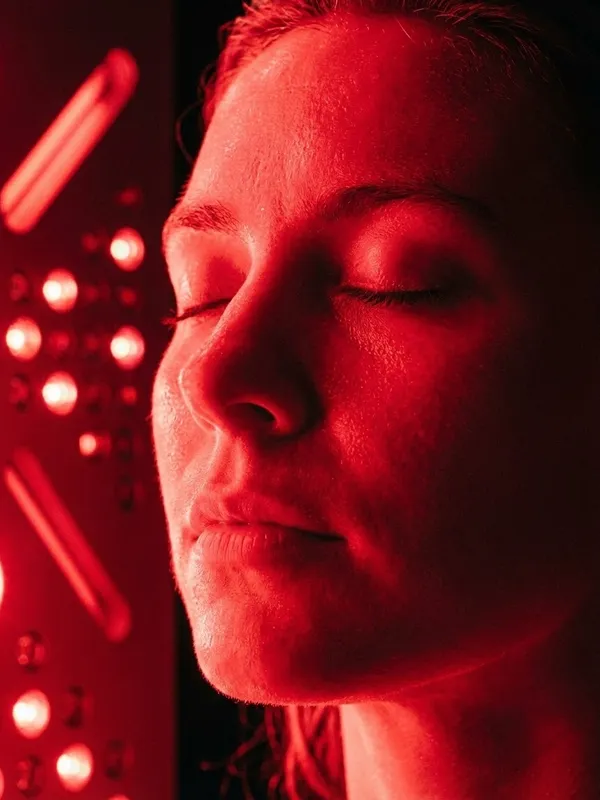
The next step, without searching.
Experiences that fit this
"Echt een aanrader voor ondernemers of mensen die even tot rust willen komen en weer helemaal willen opladen."
"Ruim vier jaar post-covid en na tweeënhalve week zuurstofkamer al verbetering."
"Zoek je een traditionele wellness, dan moet je hier niet zijn. Dit is gezondheid next level."
Want to know what this means for you?
One message is enough. We schedule a fifteen-minute intake, no obligation, and tell you honestly whether NEST fits your question.
Scientific References
"Photobiomodulation activates cytochrome c oxidase in mitochondria, increases ATP production, and modulates reactive oxygen species and nitric oxide."
"Low-dose light exposure stimulates cellular processes, while high doses inhibit them — the biphasic dose response described by the Arndt-Schulz principle."
"Photobiomodulation enhances muscle recovery and reduces muscle fatigue in healthy subjects following exercise."