Hyperbaric Oxygen Therapy (HBOT) for Brain Fog
Experiencing brain fog or indecisiveness? Discover how Hyperbaric Oxygen Therapy (HBOT) combats hypoxia in the brain and restores cognitive performance.
In the modern boardroom, ‘brain fog’ is not an option—it is a physiological failure. Whilst caffeine is merely a loan against tomorrow’s energy, hyperbaric oxygen therapy (HBOT) offers a structural solution.
The Cost of Cortisol
When you operate under high pressure, your body switches to survival mode. Blood is drawn away from the neocortex (where you make strategic decisions) and directed to the muscles. This was useful when we fled from predators, but is disastrous when you need to negotiate a merger.
The result is cerebral hypoxia: a chronic oxygen deficit in the brain. You feel this as haziness, indecisiveness and fatigue that does not disappear after a night’s sleep.
Henry’s Law
This is where physics comes into play. Normally, your red blood cells transport oxygen. However, they are already 96–99% full. Breathing more deeply therefore has little effect.
“Gas under pressure dissolves in liquid. This is not magic; this is Henry’s Law.”
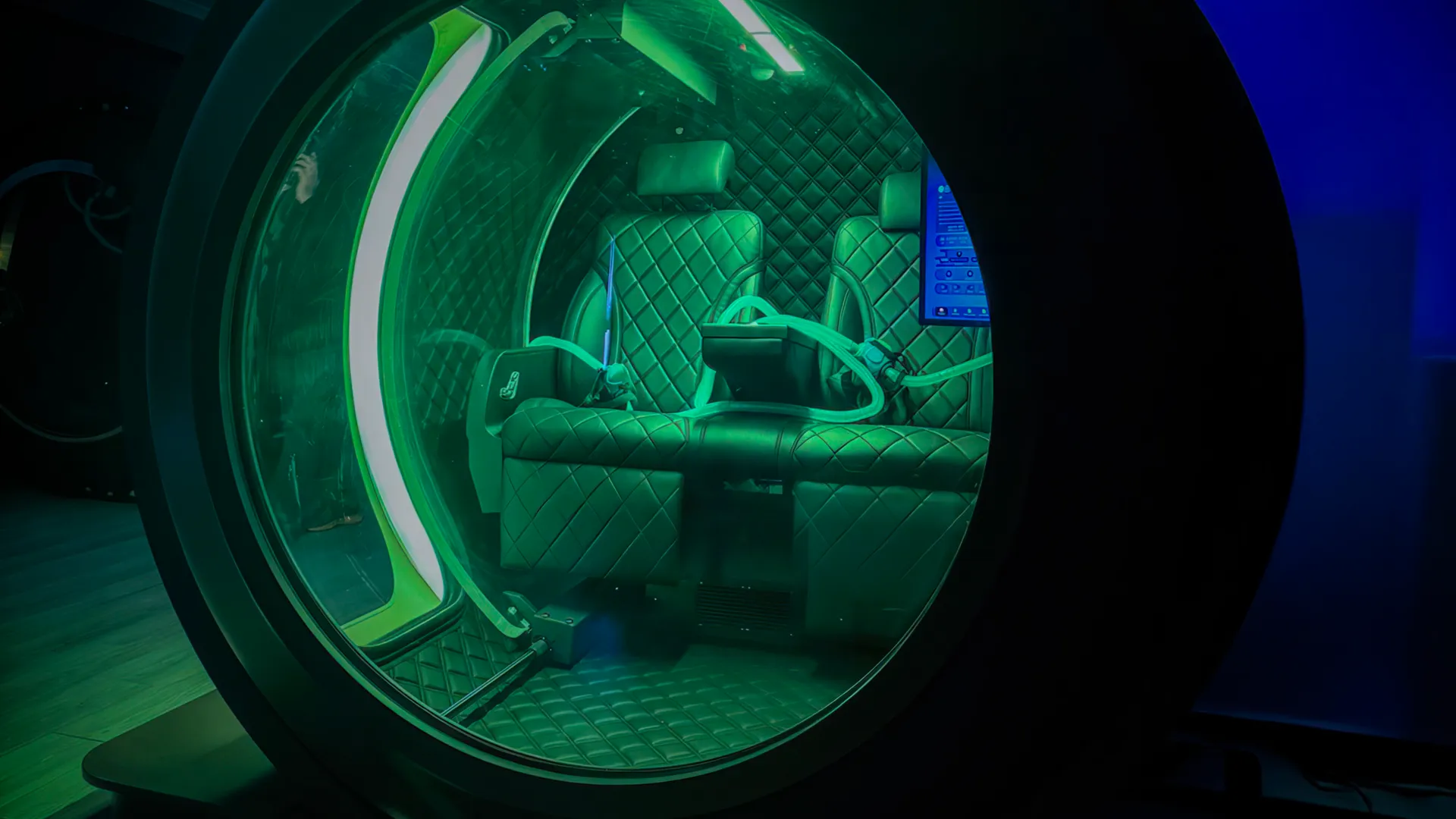
In the NEST HBOT laboratory, we place you in an environment with increased atmospheric pressure (up to 2.4 ATA), forcing oxygen to dissolve in your blood plasma, lymph fluid and cerebrospinal fluid. We bypass the red blood cells entirely. The oxygen is literally pressed into tissues that are normally unreachable through narrowed blood vessels.
Mitochondrial Biogenesis
This bath of oxygen has a powerful effect on your mitochondria, the energy plants of your cells. Older, inefficient mitochondria are broken down (autophagy) and replaced with new, powerful ones. This process is called mitochondrial biogenesis.
The consequence? Your ATP production (pure energy) shoots upward. Not through sugar or stimulants, but through more efficient combustion at the cellular level. This is exactly what we aim for in our neuro-cognitive performance retreat, where HBOT is a crucial part of the recovery cycle.
From Dissolved Oxygen to Neuronal Repair
The precision of HBOT lies in a pharmacological insight: under normobaric conditions, your blood plasma carries only 0.3 millilitres of oxygen per decilitre. This is biologically trivial. When you are in the NEST HBOT laboratory at 2.0 ATA, this value shoots to 4.4 ml O₂/dl—a fifteenfold increase.
This is not a marginal biochemical shift. This is the breaking of a classical bottleneck.
The Bypass Route
Normally, haemoglobin in your red blood cells carries virtually all oxygen. At high pressure, however, oxygen dissolves in the blood plasma itself, and in cerebrospinal fluid, the lymphatic system, and even cellular fluid. This dissolved oxygen bypasses haemoglobin entirely and reaches ischaemic (oxygen-starved) tissue directly—areas where limited blood flow would normally deliver no oxygen.
For your frontal cortex, chronically depleted under stress, this is a rebirth.
The Mitochondrial Reactivation
At the mitochondrial level, something even more remarkable occurs. Complex IV of your electron transport chain—also called Cytochrome C Oxidase—is extremely sensitive to hypoxia. When oxygen is scarce, this vital enzyme halts. ATP production collapses. Your cognitive speed slows.
At 2.0 ATA, the situation regroups radically. The elevated dissolved oxygen penetrates deep into the mitochondrial matrix, and Cytochrome C Oxidase reactivates. The electron transport chain rumbles back to life. ATP production hums again at full throttle.
This is physiological healing, not chemical masking.
BDNF: The Neurological Booster Signal
Adequate ATP enables your neurons to do something remarkable: signal neural growth. This is where Brain-Derived Neurotrophic Factor (BDNF) enters.
BDNF is no random substance. It is your brain’s own building material. It directs the creation of new neurons (neurogenesis) and the strengthening of synapses (synaptogenesis). Without BDNF your mental pathways stagnate. With BDNF they flourish.
When HBOT restores the ATP reservoir in your neurons, BDNF expression shoots upward. Your brain recalibrates toward growth. This is not separate from the cognitive recovery our clients report four to eight weeks after their HBOT programme—sharper, faster, more resilient.
This is no accident. This is neuro-architecture under control. This protocol is optimal when preceded by the priming of photobiomodulation.
Which pattern do you recognise?
Two short questions, three clear options. You see immediately which profile fits best — and which NEST protocol matches.
Which pattern do you recognise most strongly?
The next step, without searching.

Experiences that fit this
"Echt een aanrader voor ondernemers of mensen die even tot rust willen komen en weer helemaal willen opladen."
"Ondanks mijn zware werkweekend ga ik hier uitgerust vandaan."
"Een wereld waarbij de tijd stilstaat en er tegelijkertijd de mogelijkheid is om kennis te maken met technologie die zijn tijd ver vooruit is."
Want to know what this means for you?
One message is enough. We schedule a fifteen-minute intake, no obligation, and tell you honestly whether NEST fits your question.