Long Covid Recovery Programme
Hyperbaric Oxygen · Full Protocol
What this programme is
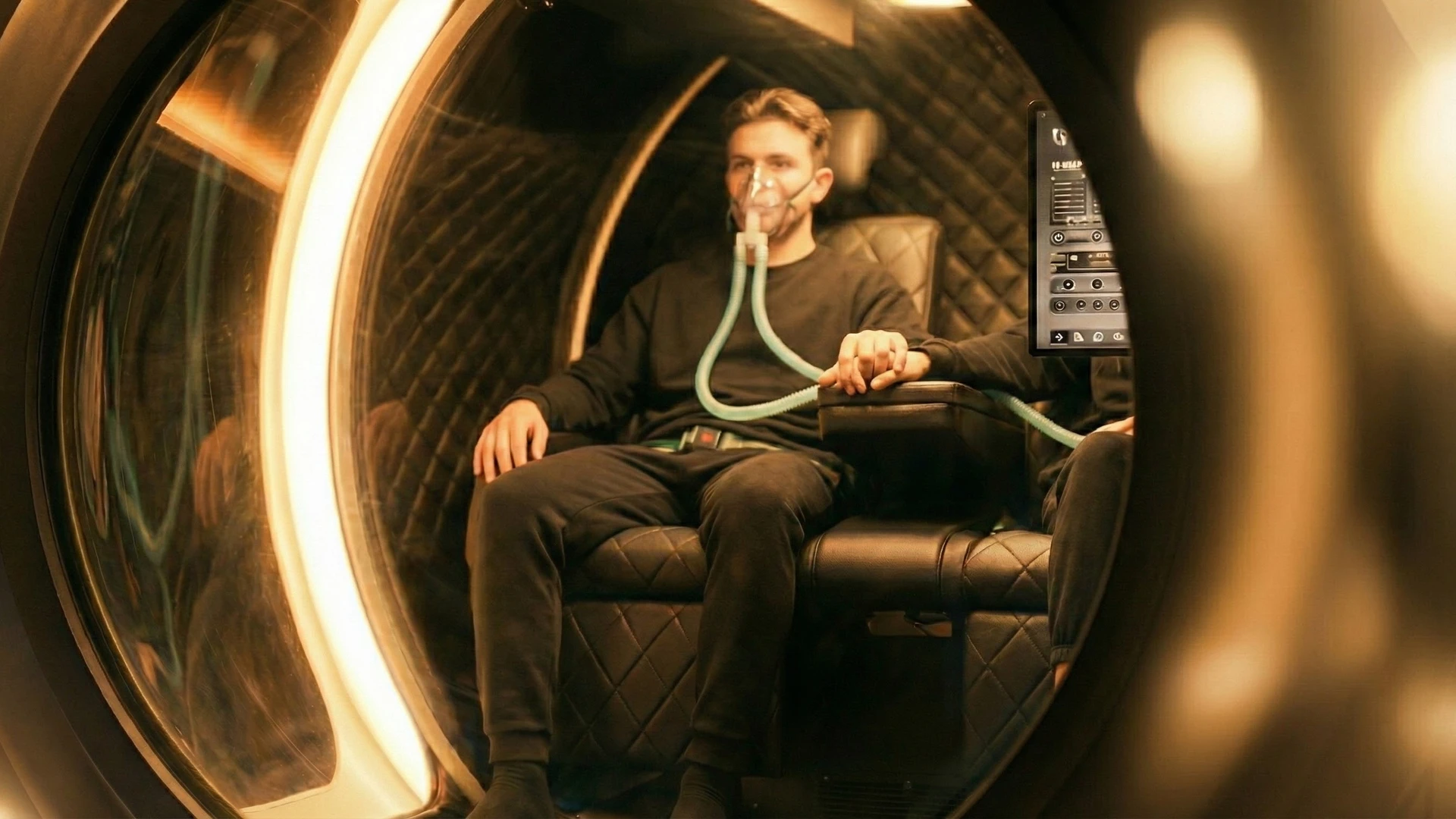
For people who still have complaints three months or longer after a corona infection: fatigue that sleep does not fix, brain fog, pain, sensory overload and poor sleep. This outpatient programme runs the full protocol of forty hyperbaric sessions — the same dose as in the research that showed an effect — embedded in rest, light and guided build-up.
You come to Luxwoude several times a week for a session of sixty to ninety minutes in our duo chamber with a chamber pressure of up to 2.4 ATA. You breathe oxygen at approximately 95% through a mask or BIBS system, with fixed air breaks per the safety standard. Beforehand You receive red light to prime cellular metabolism; immediately afterwards a rest block is fixed in the schedule.
The clinical frame
An intake always takes place first: medical history, contraindications and resilience. As a rule of thumb, You should be able to be upright and active for at least four hours a day — a lesson from the Dutch registry, where some participants deteriorated with too little capacity. Every five to ten sessions we evaluate progress; if Your symptom burden increases, we stop earlier in consultation. We measure at the start, halfway, after completion and three months later, so You see what changes.
This programme is an addition to — never a replacement for — the care of your own physician, and falls outside reimbursed standard care. What the science does and does not know, You can read in our article on hyperbaric oxygen therapy for long covid; what it feels like, Dianna tells in her story.
The installation, precisely — the spec sheet
Technical questions deserve exact answers. This is what stands here, what you breathe, and what we do and do not claim.
The chamber. A hard-shell two-person pressure chamber — not an inflatable soft chamber — with a working pressure up to 2.4 ATA. Sessions follow a fixed schedule with air breaks, the operator stays at the console with intercom contact, and exhaled gas is vented outside the chamber via the BIBS system, so oxygen does not accumulate inside.
The oxygen source. The oxygen comes from a PSA oxygen concentrator (nameplate in the safety file, available for inspection on site), not from medical cylinders. We state that precisely, because the difference is a legal one: medical oxygen in the Netherlands is a registered medicine — 100% purity, prescription-only via a physician — and that route does not exist here, so we do not claim it. Concentrator oxygen falls in the class the European Pharmacopoeia calls “Oxygen 93%”: 90 to 96 percent, with argon as the main residual gas. A single-stage concentrator has a physical ceiling around 95.7% — anyone promising “100%” from a concentrator is promising something physics does not allow.
What that means under pressure. The working measure is not the percentage but the partial pressure of oxygen: percentage times ambient pressure. Around 95% at 2.4 ATA is roughly 231 kPa — the same as 100% at 2.28 ATA, and more than ten times the 21 kPa of ordinary air. The difference between 95% and 100% at equal pressure is exactly five percent; there is no threshold or kink in between.
The measurement. A source rating is a promise; a measurement is a fact. The measurement setup is therefore fixed: an oxygen analyser samples a side stream at the mask, calibrated on outside air (20.9%), logged across full sessions including air breaks, and reported as the median over three sessions on three days — with the measurement date. We will publish the first logged series here as soon as it exists; until then, this page deliberately shows no number we have not measured.
Safety and paperwork. Inside the chamber, the clothing rules for oxygen-enriched environments apply: cotton, no oils or cosmetics, no electronics. The safety file — pressure-vessel inspection, fire-safety assessment, emergency procedures, operator certification and ambient oxygen monitoring — is being assembled and is available for inspection on site.
What we do not claim. No medical oxygen, no medical treatment, no physician attached to the organisation; participation runs through a medical self-declaration form, and a single deviating answer routes you to your own doctor before arrival. If anything on this sheet makes you doubt: come by, we will show you the installation and you can watch the measurement.
Clinical Mechanism
Repeated hyperoxia under pressure (up to 2.4 ATA) stimulates angiogenesis, stem-cell activation and mitochondrial recovery — the mechanisms disrupted in long covid. Forty sessions, the dose with demonstrated effect.
Scientific Foundation
- → "Sham-controlled RCT: 40 HBOT sessions improved neurocognition, fatigue, sleep, pain and psychiatric symptoms in post-COVID patients." [PubMed ID: 35821512]
- → "Dutch prospective registry (232 patients): 56–63% clinically relevant quality-of-life improvement three months after treatment; 13–19% deteriorated, prompting resilience criteria." [PubMed ID: DOI: 10.1038/s41598-025-11539-0]
Results
- ● The full 40-session protocol from the research
- ● Duo chamber up to 2.4 ATA, mask or BIBS
- ● Fixed measurement points and interim evaluation
The Schedule

Client Experiences
"Full-body redlight, een akoestische massage op celniveau en de hyperbare zuurstoftherapie. Na afloop een energiek en ontspannen gevoel."
"Een wereld waarbij de tijd stilstaat en er tegelijkertijd de mogelijkheid is om kennis te maken met technologie die zijn tijd ver vooruit is."
"De persoonlijke aandacht van Matthijs is heel prettig. Natuurgebied De Deelen is een aanrader."