Vagus Nerve Exercises: 7 Clinically Validated Methods for Autonomic Regulation
Vagus nerve exercises with clinical evidence: breathing techniques, cold stimulation, massage, and vibroacoustic therapy for measurable HRV improvement.
Vagus nerve exercises are your most direct access to autonomic nervous system regulation — provided you understand the neurobiology underlying them. The vagus nerve, the longest cranial nerve in the human body, controls approximately 80% of all parasympathetic signaling. Its tone — measured through heart rate variability (HRV) — determines whether your nervous system can shift between arousal and recovery or remains trapped in chronic sympathetic dominance. Most online guides recommend generic breathing exercises without neurobiological foundation. Here, you’ll learn which vagus nerve exercises are genuinely clinically validated — and when you need more than self-application.
Why Vagus Nerve Exercises Work for Stress: The Neurobiology
The vagus nerve is not a single strand but a complex network of afferent and efferent fibers. 80% of these fibers are afferent — they transmit sensory information from your body to your brain. This means: your body continuously informs your brain about current safety status. When this signal transmission is disrupted — through chronic stress, inflammation, or metabolic dysfunction — your brain interprets the environment as perpetually threatening.
Heart rate variability (HRV) is the most precise biomarker for this vagal capacity. An HRV below 30 milliseconds signals significant autonomic dysregulation. Targeted vagus nerve exercises address this dysregulation by modulating afferent input and sending safety signals to your brain.
Activating Your Vagus Nerve: 4 Exercises for Home
1. Physiological Sigh (Cyclic Sighing)
The most effective single exercise: two quick nasal inhalations followed by a prolonged mouth exhalation. A randomized controlled trial at Stanford University demonstrated that 5 minutes of daily cyclic sighing improves mood significantly more and reduces physiological arousal more than mindfulness meditation. The mechanism: prolonged exhalation activates the dorsal vagal nucleus and shifts autonomic balance parasympathetically.
2. Cold Water Facial Immersion (Dive Reflex)
Immersing your face in cold water (10-15°C) for 15-30 seconds activates the trigemino-vagal reflex. Studies confirm that cold water facial immersion triggers cardiac parasympathetic activation — independent of breath-holding or body position. Bradycardia occurs through direct vagal stimulation of the sinoatrial node.
3. Prolonged Exhalation (4-7-8 Technique)
Inhale for 4 seconds, hold for 7 seconds, exhale for 8 seconds. The prolonged exhalation phase increases intrathoracic pressure, stimulates baroreceptors, and activates the vagal baroreflexes. Two sessions of 5-10 minutes daily show measurable HRV improvements within 3-4 weeks.
4. Humming and Vocalization
Deep humming (Om vibration) or prolonged singing stimulates the vagus nerve via laryngeal musculature. Vocal cord vibration activates the recurrent laryngeal branch — a direct branch of the vagus nerve. 10-15 minutes of daily vocalization can increase RMSSD by 10-15%.
Calming Your Vagus Nerve: Exercises for Acute Overarousal
During acute sympathetic overactivation — racing heart, panic attacks, hyperventilation — preventive exercises fall short. In these moments, your nervous system requires rapid parasympathetic response:
Modified Valsalva Maneuver: Inhale deeply, close nose and mouth, press against the resistance for 10-15 seconds. The increased thoracic pressure stimulates baroreceptors in the aortic arch and activates the vagal reflex, lowering heart rate within seconds.
Cold Water on the Neck: A damp, cold cloth on the posterior neck (over the vagus nerve pathway) activates cutaneous thermoreceptors, which stimulate the parasympathetic system via afferent fibers.
Massaging Your Vagus Nerve: Auricular and Cervical Techniques
The vagus nerve has a sensory representation in the outer ear — the auricular branch. Targeted massage of the cymba conchae (inner ear) directly stimulates vagal afferents. A Bayesian meta-analysis confirms: transcutaneous auricular vagus nerve stimulation increases RMSSD, pNN50, and high-frequency HRV significantly.
Technique: Circular massage of the inner ear with thumb and index finger, 2-3 minutes per ear, twice daily. Alternatively: gentle pressure along the sternocleidomastoid muscle on the lateral neck, where the cervical vagus nerve courses.
- RMSSD
- Root Mean Square of Successive Differences — the standard measure of vagally-mediated heart rate variability. Higher values signal better parasympathetic tone.
- Cymba Conchae
- The inner area of the ear, innervated by the auricular branch of the vagus nerve — the only peripheral point where vagal afferents are transcutaneously accessible.
Vagus Nerve and Psyche: The Gut-Brain Axis Influence
The vagus nerve is the primary neural highway between gut and brain. 80% of its fibers carry sensory information from the enteric nervous system to the brainstem. The vagus nerve mediates bidirectional communication between gut microbiota and brain — a connection explaining why your gut health has direct impacts on mood, cognition, and stress resilience.
During chronic gut inflammation, vagal afferents send pro-inflammatory signals to the nucleus tractus solitarius, perpetuating central stress responses. Vagus nerve exercises can partially interrupt this cycle, but when intestinal inflammation persists, they reach their limits.
When Exercises Fall Short: Clinical Vagus Nerve Stimulation at NEST
Vagus nerve exercises are a valid starting point — but they have a physiological ceiling. If your HRV remains below 30 ms after 6-8 weeks of consistent application, if chronic exhaustion and autonomic dysregulation persist, then superficial stimulation proves insufficient. You require clinical intervention reaching deeper.
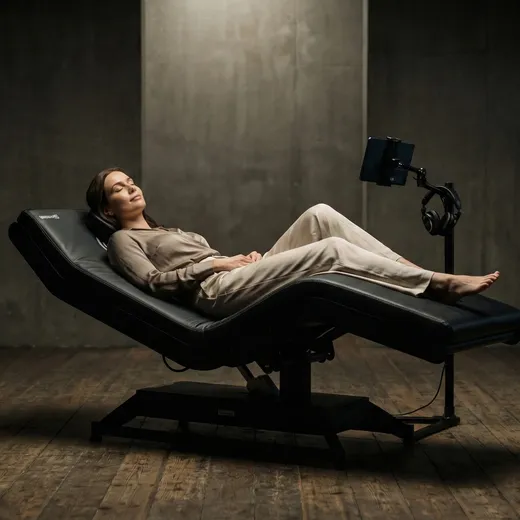
At NEST, we employ the Satori RLX System — clinical vagus nerve therapy through 40 Hz vibroacoustic stimulation. Unlike auricular self-massage, vibroacoustic therapy reaches the entire vagal pathway — from brainstem to digestive tract. Combined with vagus nerve stimulation via photobiomodulation and hyperbaric oxygen therapy, we achieve measurable HRV improvement that self-exercises alone cannot reach.
The Burnout Neuro Herstel Retreat integrates clinical vagus nerve protocols into a multi-day program systematically restoring your autonomic capacity. Not as replacement for daily exercises — but as the clinical foundation upon which your self-work becomes genuinely effective.
Core Message: Vagus nerve exercises are not optional wellness programming — they are neurobiological tools for autonomic regulation. Yet when your nervous system is chronically dysregulated, you need clinical depth that self-application cannot deliver. Begin with the exercises. Measure your HRV. And when the numbers stall — it is time for the next step.
Which pattern do you recognise?
Two short questions, three clear options. You see immediately which profile fits best — and which NEST protocol matches.
Which pattern do you recognise most strongly?
The next step, without searching.
Experiences that fit this
"Zoek je een traditionele wellness, dan moet je hier niet zijn. Dit is gezondheid next level."
"Echt een aanrader voor ondernemers of mensen die even tot rust willen komen en weer helemaal willen opladen."
"En die bedden... wauw! Zó comfortabel dat we er bijna niet meer uit wilden."
Want to know what this means for you?
One message is enough. We schedule a fifteen-minute intake, no obligation, and tell you honestly whether NEST fits your question.
Scientific References
"Cyclic sighing (5 minutes daily) improves mood and reduces physiological arousal significantly more than mindfulness meditation."
"Cold water facial immersion triggers cardiac parasympathetic activation per se — independent of breath-holding or body position."
"Transcutaneous auricular vagus nerve stimulation increases RMSSD, pNN50, and HF-HRV significantly in a Bayesian meta-analysis."
"The vagus nerve mediates bidirectional communication between gut microbiota and brain as an interface."