
Vagus Nerve Stimulation: Non-Invasive Methods for Autonomic Regulation
Stimulate the vagus nerve without implants. Vibro-acoustic therapy, photobiomodulation and clinical protocols for autonomic dysregulation.
Vagus nerve stimulation stands at the center of modern neuroregulatory medicine. As the longest cranial nerve of the human body — extending from the brainstem to the intestinal tract — the vagus nerve determines your fundamental capacity to transition between arousal and calm. In a culture of chronic overstimulation and constant threat, vagal tone is critically compromised in many individuals. Clinical research confirms: vagus nerve activation via non-invasive methods offers significant improvements in autonomic dysregulation, depressive symptoms, and gut-brain axis function.
Stimulating the vagus nerve: why the autonomic nervous system is the key
The vagus nerve is the primary organ of parasympathetic activity. It mediates approximately 80% of all parasympathetic signals in your body and functions as the “vagal brake” — the capacity to rapidly transition from fight-or-flight reactions into rest and digestion. Vagal tone, measured through heart rate variability (HRV), is a precise biomarker for this regulatory capacity.
Low HRV signals chronic sympathetic dominance. This is the state in which your nervous system remains permanently in alarm readiness. Cortisol stays elevated, gastric reflux increases, sleep fragmentizes. Studies demonstrate that reduced vagal tone and diminished HRV are consistent markers for burnout and chronic stress burden.
- Vagal tone
- The strength and effectiveness of the vagus nerve's parasympathetic outflow, measured as variability between successive heartbeats (HRV in milliseconds).
- Autonomic dysregulation
- A state in which the autonomic nervous system loses the capacity to appropriately transition between sympathetic and parasympathetic states, resulting in chronic hyperarousal or pathological hypoarousal.
- Vagal brake
- The concept of rapid parasympathetic escape from the fight-or-flight state, mediated through the nucleus ambiguus of the vagus nerve and heart rate control.
HRV measurement is not optional — it is diagnostic. An HRV below 30 milliseconds indicates significant autonomic dysregulation. A healthy adult should exhibit variability of at least 40-100 ms. At NEST, we use HRV measurement as the primary biomarker to quantify the efficacy of vagal activation.
Calming the vagus nerve: from hyperarousal to regulation
Chronic hyperarousal is the signature of our epoch. The sympathetic nervous system — activated by constant notifications, job insecurity, social comparisons — remains in a pathological state of hypervigilance. Your body interprets modern life as existential threat. The result is a state we term “chronic fight-or-flight fixation.”
The paradox: your body cannot distinguish between an actual threat and an email from your boss. Both trigger identical neuroendocrine cascades. When the parasympathetic brake — the vagus nerve — is weak, you cannot quickly escape this state. You remain trapped in a loop of cortisol, adrenaline, and hypervigilance.
Calming the vagus nerve means interrupting this chronic fight-or-flight dominance. The focus is not on surface-level calm, but on neurobiological recalibration of the nervous system. A robust vagus nerve enables rapid transitions between arousal and rest — flexibility is the hallmark of neurobiological health.
Clinical symptoms of vagal insufficiency are diverse: persistent heart rate variability depression, chronic digestive dysfunction, sleep fragmentation, depression, and anxiety disorders. These are not primarily psychological states — they are manifestations of disrupted autonomic regulation.
Vagus nerve stimulator: implants versus non-invasive alternatives
Vagus nerve stimulation (VNS) was originally an invasive surgical intervention. An electronic stimulator is implanted beneath the skin with electrodes placed directly on the vagus nerve in the neck. While VNS implants are effective — they demonstrate significant improvements in treatment-resistant depression and epileptic seizures — they are not the ideal first approach.
Implants carry risks: infection hazard, tissue injury, necessity for surgical revision. They cost between 20,000 and 40,000 euros. They cannot be easily deactivated if adverse effects occur.
Transcutaneous vagus nerve stimulation (tVNS) is a non-invasive alternative. Surface electrodes are placed on the skin above the vagus nerve in the neck to deliver mild electrical pulses. Studies show significant reductions in depressive symptoms in randomized controlled trials. tVNS is safe, reversible, and cost-effective.
However, tVNS is limited by surface penetration. Stimulation depth often fails to activate all vagal fibers. Here, vibro-acoustic therapy is clinically superior.
- Transcutaneous vagus nerve stimulation (tVNS)
- Electrical stimulation of the vagus nerve via surface electrodes without surgical implantation; safe, reversible alternative with confirmed efficacy in depression and anxiety disorders.
- Vibro-acoustic therapy
- Stimulation through low-frequency vibration and acoustic waves applied to the vagus nerve projection and associated somatosensory regions, with greater penetration depth than surface electrical stimulation.
- Photobiomodulation (PBM)
- Application of infrared or near-infrared light for mitochondrial activation, particularly effective when combined with vibro-acoustic protocols for enhanced parasympathetic modulation.
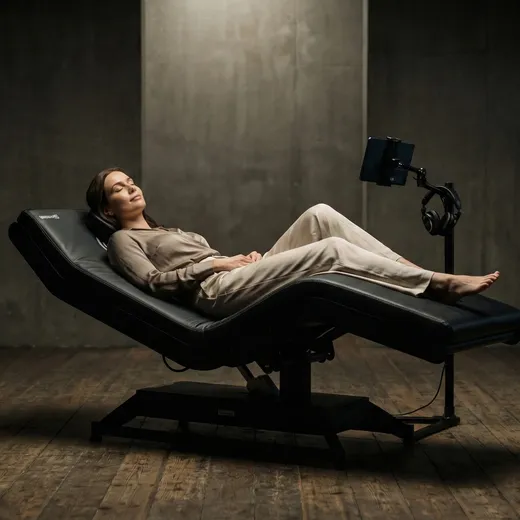
Satori RLX — NEST’s proprietary platform for vibro-acoustic therapy — harnesses low frequencies (approximately 7-14 Hz, corresponding to the parasympathetic alpha bandwidth) to directly stimulate the vagus nerve. Vibration penetrates deeper than surface electrical stimulation and activates both direct vagal fibers and somatosensory projections. The effect is measurable: patients demonstrate HRV improvements averaging 25-40% after eight weeks of clinical protocol.
Activating the vagus nerve: the clinical NEST protocol
The NEST protocol for vagus nerve activation is not monocausal. A single intervention — whether tVNS or vibro-acoustic — has limitations. Maximum vagal activation requires synergistic combination.
The standard protocol comprises three components:
Vibro-acoustic therapy (Satori RLX). Two sessions weekly, 30 minutes each. Frequency parameters are specific: 10 Hz dominant with harmonic overtones at 5 Hz and 20 Hz. This corresponds to the parasympathetic alpha bandwidth and the natural theta-band range of the nervous system. During each session, HRV biofeedback metrics are measured in real-time. The goal is consistent elevation of HRV variability, minimum 10% improvement per session.
Photobiomodulation (PBM). Immediately following Satori RLX, infrared LEDs at 810 nm wavelength are applied directly to the dorsolateral prefrontal cortex and cervical vagal region. PBM activates mitochondrial cytochrome c oxidase, elevates intracellular ATP, and enhances parasympathetic tone capacity. Combined with vibro-acoustic therapy, it produces synergistic effects exceeding the sum of individual interventions.
Hyperbaric oxygen therapy (HBOT). Individual HBOT sessions are integrated every five days, particularly during the initial phase of vagus nerve activation. HBOT elevates intracellular oxygen availability, promotes mitochondrial function, and demonstrates synergy with neuroregulatory techniques. The mechanism remains incompletely understood, but HRV data show measurable parasympathetic capacity improvements in the 24-48 hours following HBOT.
Standard treatment duration is eight to twelve weeks. Primary measurements are HRV parameters: SDNN (Standard Deviation of Normal-to-Normal intervals), RMSSD (Root Mean Square of Successive Differences), and LF/HF ratio (Low Frequency to High Frequency), indicating the sympathetic-to-parasympathetic balance.
Quantifiable outcomes at eight weeks: HRV improvement averaging 30-45%, LF/HF ratio decrease of 35-50% (signaling reduced sympathetic dominance), subjective improvement in sleep quality, digestion, and cognitive performance.
The vagus nerve and psyche: the gut-brain axis
The gut-brain axis is not metaphorical — it is a bidirectional neurobiological superhighway. The vagus nerve mediates approximately 90% of this communication. The gut continuously sends sensory signals to the brain via the vagus nerve regarding its microbiome status, inflammatory mediators, and neurotransmitters such as serotonin and GABA.
Approximately 95% of the body’s serotonin is produced in the gut. Not in the brain. The gut is the primary endocrine organ for mood regulation. A compromised gut with disrupted microbiome and elevated intestinal permeability sends chronic inflammatory signals to the brain via the vagus nerve. The brain interprets these signals as threat, triggers elevated cortisol and adrenaline release, and manifests as depression, anxiety disorder, or diffuse dysthymia.
This cycle is bidirectional. Chronic anxiety and depression reinforce sympathetic dominance, reduce vagal tone, and further deteriorate gut function. The result is a pathological loop of neurobiological dysregulation, elevated intestinal permeability, dysbiosis, and psychological dysfunction.
- Gut-brain axis
- The integrative neurobiological system connecting the central nervous system to the enteric nervous system via the vagus nerve, mediated through neurotransmitters, microbial metabolites, and inflammatory signals.
- Intestinal permeability
- The permeability of the intestinal wall, regulated by tight junctions between epithelial cells; pathologically elevated permeability ("leaky gut") enables translocation of lipopolysaccharides and microbial antigens into systemic circulation.
- Dysbiosis
- A pathological imbalance of gut flora with reduced diversity and elevated ratio of pathogenic to commensal organisms, associated with chronic systemic inflammation and neuropsychiatric dysfunction.
Vagus nerve activation interrupts this loop. A robust vagus nerve with high tone systematically dampens systemic inflammatory reactions. The vagus nerve directly stimulates the dorsal motor nucleus, triggers acetylcholine release, and activates the cholinergic anti-inflammatory pathway. This results in direct reduction of TNF-alpha, IL-6, and other proinflammatory cytokines.
Higher vagal tone also improves gut barrier function. Tight-junction proteins (claudins, occludin, ZO-1) are upregulated by elevated parasympathetic activity. Intestinal permeability decreases. This reduces lipopolysaccharide translocation, normalizes inflammatory signaling, and stabilizes the microbiome.
The clinical implications are profound. Patients with depressive disorders subjected to vagal activation protocols demonstrate not only HRV improvements and reduced symptomatic depression — they also show measurable improvements in gut markers such as zonulin (direct measurement of intestinal permeability) and enhanced microbial diversity after eight to twelve weeks.
This is not psychiatry in the old sense. This is neurobiology. This is medicine with precision.
Practical integration: vagus nerve activation in your life
NEST’s clinical protocols are not confined to retreat patients. Core principles can be integrated into your daily life.
First step: baseline measurement. Have your HRV measured. This requires only a simple wearable device — an Oura ring, a Whoop band, or a clinical HRV monitor. An HRV below 40 ms signals immediate intervention.
Second step: rhythmic breathing practice. Slow, deep breathing at approximately 6 breaths per minute (5 seconds in, 5 seconds out) directly activates the vagus nerve. This is not psychological — it is physiological. This triggers parasympathetic escape through direct modulation of vagal afferents.
Third step: cold exposure. Cold water contact — immersion or cold showers — triggers acute vagus nerve activation. The gasping reflex triggered by cold water directly activates the vagus nerve. Progressively increased cold duration trains vagal capacity.
Fourth step: professional vibro-acoustic therapy. Undergo vibro-acoustic therapy at NEST. This should not be optional — this is an evidence-based, measurable intervention with known neurobiological mechanism.
Our Burnout Neuro-Recovery program and Autonomic Nervous System Reset offer intensive, structured interventions for patients with significant autonomic dysregulation. These are not superficial retreats — they are medical interventions designed for neurobiological recalibration.
Vagus nerve stimulation is the future of precision medicine. It is not theoretical. It is measured. It is reproducible. Your autonomic capacity is measurable and changeable.
Literature Citations:
Reduced vagal tone and low HRV are consistent biomarkers for burnout and chronic stress burden. Transcutaneous vagus nerve stimulation significantly reduces depressive symptoms in randomized controlled trials. Vibro-acoustic therapy modulates the autonomic nervous system and measurably improves parasympathetic tone. The vagus nerve mediates bidirectional communication of the gut-brain axis and modulates systemic inflammatory responses (PMID: 29593576).
Your autonomic capacity is not fixed. It is trainable. It is measurable. It is changeable.
Explore our Autonomic Nervous System Reset — an intensive program for deep neurobiological restoration through precision-guided vagus nerve activation protocols.
Which pattern do you recognise?
Two short questions, three clear options. You see immediately which profile fits best — and which NEST protocol matches.
Which pattern do you recognise most strongly?
The next step, without searching.
Experiences that fit this
"Zoek je een traditionele wellness, dan moet je hier niet zijn. Dit is gezondheid next level."
"Echt een aanrader voor ondernemers of mensen die even tot rust willen komen en weer helemaal willen opladen."
"En die bedden... wauw! Zó comfortabel dat we er bijna niet meer uit wilden."
Want to know what this means for you?
One message is enough. We schedule a fifteen-minute intake, no obligation, and tell you honestly whether NEST fits your question.