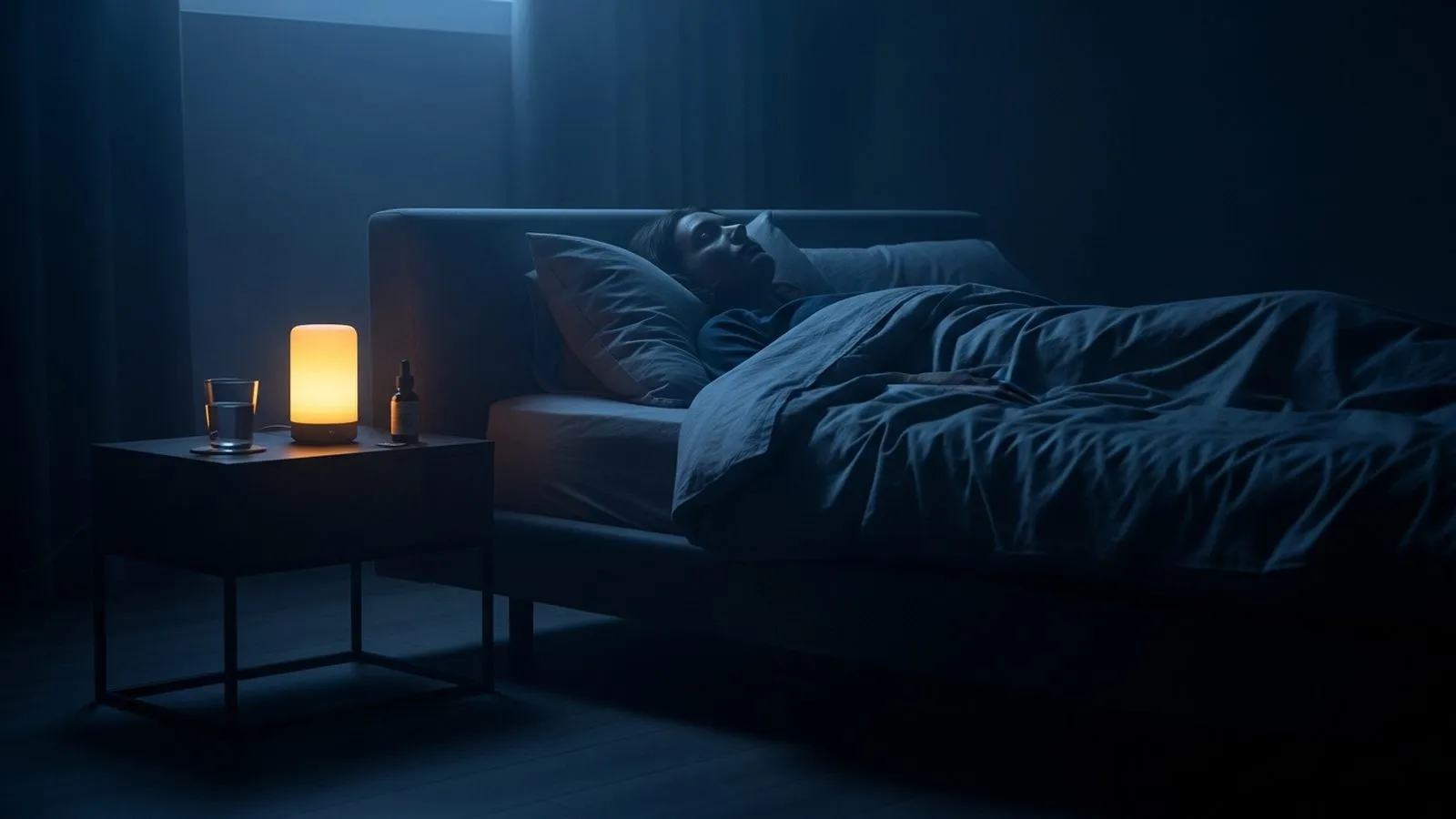
Tired but wired — The hyperarousal mechanism that couples exhaustion to alertness
Tired but wired is not psychological rumination but a hardware fault: hyperarousal of the central nervous system, high nocturnal cortisol, and a vagal tone that no longer switches over. The clinical reading and the intervention that breaks the pattern.
You are exhausted. You drag yourself through the day, count the hours until you can finally go to bed, and then your eyes will not close. Or they close and you fall into a shallow half-sleep from which you wake fully around 3 a.m. Tired but wired is not a contradiction — it is a precisely describable neurobiological state called hyperarousal. The nervous system is simultaneously exhausted and alert, and the two states block one another. This article explains the mechanism, shows what sleep architecture makes of it, and describes what is required to break the pattern.
The picture is not a subjective feeling and not a mental problem. It is a measurable derailment of three axes — cortical arousal, HPA axis, autonomic balance — that sustains itself independent of rumination or stress snapshot. Those who have this picture do not become calm in the evening with meditation alone; the system simply needs a different signal to switch over. Distinguishing between trouble falling asleep due to mental restlessness and trouble falling asleep due to physiological alertness is the difference between a manageable problem and a chronic pattern. The first responds to cognitive intervention; the second requires biological reconditioning.
The paradox — exhaustion and alertness at the same time
What the literature calls hyperarousal is not heightened wakefulness layered onto a normal sleep system. It is a 24-hour shift in which cortical activation never fully drops. EEG research shows elevated high-frequency activity (beta band) throughout the night — even during what polysomnography records as sleep. Cognitively this translates into rumination; physiologically into elevated resting heart rate, lowered HRV, and elevated body temperature in the evening when it should be falling.
The paradox of exhaustion plus alertness is physiologically not a paradox: fatigue is a marker of metabolic debt and mitochondrial depletion, while alertness is a marker of sympathetic activation. Both can — and in hyperarousal insomnia must — be present simultaneously. The brain says “I need energy” and the nervous system says “I cannot hand over the watch.” That is not weakness. It is a calibrated safety system that no longer switches.
The review by Riemann et al. (PMID 19481481) describes this as the core of insomnia pathophysiology: not a shortage of sleep drive, but an excess of arousal that blocks sleep initiation. The update by Dressle & Riemann (PMID 37183177) confirms the picture with new data: hyperarousal is not a co-symptom, it is the principal mechanism.
What sleep architecture shows
Anyone who grants themselves “seven hours in bed” yet does not recover is structurally sleeping shallow. Polysomnographic research in insomnia with objective short sleep duration (Vgontzas et al., PMID 23419741) shows three consistent patterns. One: REM sleep is fragmented. The REM periods are shorter, are interrupted more often, and REM density (eye movements per minute) is elevated — a marker of emotional non-processing. Two: the N3 phase (deep slow-wave sleep) is shortened. N3 is the phase in which glymphatic clearance occurs and growth hormone peaks; a deficit means physical non-recovery, regardless of how many hours one spends in bed. Three: early-morning awakenings between 4 and 5 a.m., followed by lying awake until the alarm.
Subjectively measured (“I slept reasonably”) and objectively measured (polysomnography or EEG wristband) often diverge in this picture. Some patients underestimate their sleep (sleep-state misperception); others overestimate it — both groups have the same physiological disturbance. The variable that actually matters is not felt but measured architecture. Anyone who has a 7-day sleep registration done receives the truth instead of hope.
It is this objective picture that breaks the illusion of “I just need to stay in bed a little longer.” The problem is not in time-in-bed but in phase distribution within that time.
The normal values put the picture in perspective. In a healthy adult between 30 and 60 years, a night consists of roughly 20 to 25% deep N3 sleep, 20 to 25% REM, and the rest in N1/N2. In hyperarousal insomnia N3 often falls below 10% — a loss of more than half. REM can remain intact in absolute volume but is fragmented into short pieces that do not complete a full cycle. Net effect: seven hours in bed deliver less restorative sleep than five healthy hours in a normally sleeping system. Anyone who says “I sleep enough but do not feel it” is describing precisely this phase distribution.
Cortisol — why you wake at 3 a.m.
Cortisol is a rhythmic hormone: high in the morning (cortisol awakening response, CAR), steadily declining over the day, a trough around midnight, and a steady rise from around 3 a.m. in preparation for waking. In a healthy HPA axis this trough is deep enough to allow deep sleep, and the morning rise is gradual enough not to make waking abrupt.
In hyperarousal insomnia this rhythm derails on three axes simultaneously (Elder et al., PMID 23835138). The CAR is elevated: cortisol peaks higher in the morning, often above the normal 50% rise relative to the moment of awakening. The nocturnal trough is shallow: cortisol stays higher at night than it should, physiologically preventing deep sleep. And the pre-awakening rise starts too early, often around 02:30–03:30, which clinically produces the characteristic 3 a.m. wake.
The mechanism behind that nocturnal spike is seldom purely psychological. It is a combination of hypoglycaemia (liver glycogen depleted), elevated sympathetic tone, and an HPA axis that has lost its negative-feedback loop. The system treats every small physiological perturbation as a mini-emergency and responds with adrenaline and cortisol. You do not wake because you sleep lightly; you wake because your adrenals are firing an alarm.
Anyone who acts only on the subjective complaint — better sound insulation, better blackout, better bedding — addresses none of these three derailments. The cortisol curve is measurable in a 4-point saliva test and is the first objectifiable data point.
Stress, rumination, and how vagal tone falls
The vagus nerve is the main cable of the parasympathetic nervous system — the system that enables sleep, digestion, recovery, and rest. Vagal tone, the functional level of this activity, is measured non-invasively as heart rate variability (HRV), specifically the RMSSD component (root mean square of successive differences). A healthy nocturnal RMSSD lies between 40 and 80 ms; in hyperarousal insomnia it sits structurally below 25 ms and not infrequently below 20 ms.
Low RMSSD means the parasympathetic brake is no longer effectively applied at the heart. The sympathetic system dominates even at rest. That is precisely what the update by Dressle & Riemann (PMID 37183177) describes as the pathophysiological core: not only at night but 24 hours a day the system is insufficiently parasympathetic. Sleeping becomes biologically hard because sleep requires parasympathetic dominance that is simply not activated.
For those who want to understand the physiology: HRV as the objective measure of stress and recovery explains the metric. For those who want to correct it: Vagus-nerve stimulation — from DIY to clinical precision discusses the intervention ladder. The rumination cycle that presents itself in the evening is in this context not a cause but a consequence: the brain perceives the physiological alertness and finds content to match. Stopping rumination does not work if vagal tone keeps feeding the alertness.
The reverse causality is the most important insight here. Classically thought: stressful day → rumination → poor sleep. The mechanism in chronic hyperarousal is reversed: low vagal tone → physiological alertness at rest → the brain searches for cognitive material that matches that alertness → rumination. Anyone intervening only on the rumination — mindfulness, meditation, sleep-meditation apps — is addressing the top layer. It works sometimes, not structurally, and fails at every new external stressor. The physiological base must be recalibrated first.
Why sleep tips do not work when the hardware problem is unresolved
Sleep coaching, sleep hygiene, and cognitive behavioural therapy for insomnia (CBT-I) provide valuable building blocks. Stimulus control (only go to bed when sleepy), sleep restriction (limiting time-in-bed to actual sleep time), and cognitive restructuring (calibrating catastrophic thoughts about sleep) measurably reduce subjective complaints. For classic insomnia, CBT-I is first-line.
In hyperarousal insomnia the approach hits a wall: the patient learns to cope better with the physiological disturbance, but the disturbance itself remains. The cortisol curve stays flattened, RMSSD stays low, sleep architecture stays fragmented. Improving subjectively without recovering objectively is a worthwhile development — but it is not the same as solving the problem. Anyone who does not actively restore the three biological axes remains vulnerable to relapse at the next stressor.
The practical implication: CBT-I and biological intervention together deliver the tipping effect that neither delivers alone. That is the position from which a protocol-based approach makes sense.
The NEST approach — Autonomic Reset Protocol (The Bridge)
For those who want to break the hyperarousal state without taking six months of sick leave, there is a targeted ambulatory intervention: The Bridge — Autonomic Nervous System Reset, a one-day protocol in our facility for €595. It is not a weekend retreat and not a relaxation day. It is a precision intervention that addresses the three axes simultaneously.
The stack: EMS stimulation to restore peripheral proprioceptive input to the central nervous system; 40Hz transcutaneous vagal stimulation to directly elevate parasympathetic activity and RMSSD; an Optic Flow protocol to calibrate the visual system toward physiological rest. The combination is calibrated to measurable HRV rise within a single session — on average a 30 to 60% acute increase, with residualisation in the three to seven days that follow.
You begin the day with a baseline measurement (HRV, breathing pattern, autonomic balance). You go through three intervention blocks with rest moments in between. You end with a closing measurement and a protocol for home consolidation: what to do to lock in the gain. The effect is not a quick fix in the sense that one day resolves a chronic picture, but it is the tipping moment that breaks the self-feeding cycle and lets subsequent interventions — sleep hygiene, CBT-I, eventual medication tapering — act on a receptive system.
The practical logic behind a one-day ambulatory: in hyperarousal insomnia the bottleneck is not time but signal. The system does not need six weeks of rest to relax; it needs a biologically convincing signal that the watch can be handed over safely. Three calibrated stimuli on one day, in the right order, deliver that signal. What happens afterwards — at home, with measurement — determines whether the gain residualises or not. You do not get advice; you get a protocol. The difference is measurable in your own RMSSD.
For those who want to read further on the physiology of vagal stimulation: vagus-nerve therapy in the lab describes the technique. The Bridge is not the right entry point for everyone — in acute crisis or medication dependence a different starter protocol applies. We distinguish that at intake.
Core message
Tired but wired is not a character weakness, not a mental error, and not a question of better sleep hygiene. It is a neurobiological state with three measurable derailments — cortical hyperarousal, derailed HPA axis, low vagal tone — that feeds itself as long as you intervene only on behaviour. Anyone who wants to break the pattern has to address the hardware. That begins with measuring objectively and ends with intervening precisely on the axes that are actually derailed. Sleep is not an achievement. It is a physiological state that presents itself once the nervous system receives permission to hand over the watch. Our task is to make that permission biologically possible.
Which pattern do you recognise?
Two short questions, three clear options. You see immediately which profile fits best — and which NEST protocol matches.
Which pattern do you recognise most strongly?
The next step, without searching.
Experiences that fit this
"Zoek je een traditionele wellness, dan moet je hier niet zijn. Dit is gezondheid next level."
"Echt een aanrader voor ondernemers of mensen die even tot rust willen komen en weer helemaal willen opladen."
"En die bedden... wauw! Zó comfortabel dat we er bijna niet meer uit wilden."
Want to know what this means for you?
One message is enough. We schedule a fifteen-minute intake, no obligation, and tell you honestly whether NEST fits your question.
Scientific References
"Insomnia is a 24-hour hyperarousal disorder in which increased cognitive, emotional, cortical and physiological activation prevents sleep onset, maintenance and recovery."
"Insomnia with objective short sleep duration shows characteristic changes in sleep architecture — fragmentation, REM shift and deep-sleep deficit — and represents the biologically most severe phenotype of the disorder."
"The cortisol awakening response and nocturnal cortisol levels are direct markers of HPA-axis activity and correlate with sleep quality, sleep duration and insomnia pathophysiology."
"Hyperarousal in insomnia disorder involves increased sympathetic activation, reduced vagal tone (low HRV/RMSSD), and consistent deviations in HPA-axis function — a mechanistic update confirms arousal as the core pathology."