
Vagus Nerve Exercises: What Actually Works — and When Exercises Aren't Enough
Vagus nerve exercises for home practice + clinical stimulation for chronic dysregulation. With HRV measurement and PubMed evidence.
You breathe shallowly. Your resting heart rate sits at 78. After a full day of work, Your nervous system feels as though someone forgot to turn the engine off. You’ve read that the vagus nerve is the key. The internet recommends gargling, humming, and cold showers. But which vagus nerve exercises actually work — and when are exercises alone no longer sufficient?
Why the Vagus Nerve Is the Key to Stress Regulation
The vagus nerve is the longest cranial nerve in Your body. It extends from the brainstem through Your neck, thorax, and abdomen, innervating the heart, lungs, digestive tract, and additional organs. Its primary function in the context of stress regulation: it is the parasympathetic “brake” of the sympathetic nervous system.
- Vagal Tone
- The baseline activity of the vagus nerve at rest, measurable via heart rate variability (HRV). High vagal tone means: Your nervous system can efficiently shift between activation and recovery. Low vagal tone means: the system remains stuck in sympathetic dominance.
- Ventral Vagal Complex
- Porges described in his Polyvagal Theory a phylogenetically newer, myelinated branch of the vagus that mediates social engagement and finely tuned autonomic regulation. This ventral vagal system enables rapid heart rate modulation without complete shutdown — the foundation for adaptive stress regulation.
- RMSSD
- Root Mean Square of Successive Differences — the HRV parameter that most reliably reflects vagal activity. Normal values vary by age, but RMSSD below 20 ms is considered an indicator of substantially reduced vagal tone.
Understanding these fundamentals is critical: not every exercise that feels good actually stimulates the vagus nerve. The only objective measure is measurable change in HRV. This is precisely where evidence-based vagal stimulation differs from what circulates as a “vagus hack” in social media short videos.
The vagus nerve has two main directions: afferent fibers (80% — send information from the body to the brain) and efferent fibers (20% — send commands from the brain to the body). Most self-directed exercises target afferent stimulation: they send a signal to the brainstem that increases parasympathetic output. Clinical stimulation can address both directions directly.
5 Vagus Nerve Exercises with Clinical Evidence
The following five exercises have documented effects on vagal parameters. For each exercise: the mechanism, dosing, and limitations.
1. Resonant Breathing (5.5 Breaths/Minute)
Mechanism: Breathing at Your individual resonant frequency (typically 5–7 breaths/minute) maximizes respiratory sinus arrhythmia. Inhalation accelerates heart rate (sympathetic), exhalation decelerates it (parasympathetic). At resonant frequency, this oscillation is maximally amplified.
Dosing: 2x daily for 10 minutes. Inhalation 4–5 seconds, exhalation 5–6 seconds. An RCT documented significant improvements in HRV, mood, and blood pressure.
Limitation: Assumes an intact baroreflex loop. With chronic autonomic dysregulation, the resonant frequency can shift or amplitude can be greatly reduced.
2. Cold Face Exposure (Diving Reflex)
Mechanism: Cold water on the forehead and cheeks (the trigeminal nerve area, V1 branch) triggers the diving reflex — a phylogenetically ancient response that induces bradycardia and peripheral vasoconstriction. The meta-analysis by Porzionato et al. confirmed: the diving reflex activates cardiac vagal activity independent of breath-holding.
Dosing: Cold water (10–15°C) applied to the face for 30–60 seconds. Alternatively: submerge Your face in a bowl of cold water. Most effective in the morning.
Limitation: Contraindicated in certain cardiac arrhythmias. Only trigeminal dermatomes (face) reliably trigger the reflex — cold showers on the body operate through a different mechanism.
3. Humming and Gargling
Mechanism: The vagus nerve innervates laryngeal muscle via the recurrent laryngeal nerve. Vibrations from humming (particularly low-frequency, “Om”-like) and gargling activate this connection and stimulate afferent vagal fibers.
Dosing: 3–5 minutes of deep humming, 2–3x daily. Gargle with water for 30–60 seconds after brushing Your teeth.
Limitation: The effect is measurable but moderate. With substantially reduced vagal tone, insufficient for clinically relevant improvement on its own.
4. Vagus Nerve Eye Exercises
Mechanism: Slow lateral eye movements activate parasympathetic nuclei in the brainstem through the oculomotor complex. The connection between eye motor function and autonomic regulation is neuroanatomically documented via the Edinger-Westphal nucleus.
Dosing: Slowly direct Your gaze to the right, hold for 15–20 seconds, then to the left. 5 repetitions. Can be combined with resonant breathing.
Limitation: The evidence base for isolated vagus nerve eye exercises is less robust than for breathing and cold exposure. Most effective as part of a combined protocol.
5. Slow, Conscious Chewing
Mechanism: The vagus nerve innervates the digestive tract. Slow chewing (30+ chewing movements per bite) activates vagal control of digestion and signals Your nervous system: no danger, energy extraction possible. The cephalic phase of digestion is initiated via vagal afferents.
Dosing: Each meal for at least 20 minutes. No screens, no distractions. Focus on texture and flavor.
Limitation: Indirect vagal activation. Insufficient as a standalone intervention, but valuable as part of a vagal training protocol.
The Combined Home Protocol
The five exercises reach their maximum effectiveness not in isolation, but as a structured protocol:
| Time of Day | Exercise | Duration | Frequency |
|---|---|---|---|
| Morning (fasting) | Cold face exposure | 30–60 sec | Daily |
| Morning | Resonant breathing | 10 min | Daily |
| Before meals | Humming/gargling | 3 min | 2–3x daily |
| During meals | Conscious chewing | 20+ min | Each meal |
| Evening | Resonant breathing + eye exercises | 10 min | Daily |
The sequence is not arbitrary. Morning cold exposure activates the diving reflex and creates a parasympathetic window. The subsequent resonant breathing amplifies this effect. Exercises before and during meals support vagal control of digestion. The evening combination of breathing and eye exercises prepares Your nervous system for nighttime recovery.
Activating the Vagus Nerve: HRV as the Success Metric
The only method to objectively evaluate the success of vagus nerve exercises is measurement of heart rate variability. Subjective relaxation does not reliably correlate with vagal activation.
The measurement protocol:
| Parameter | Measurement Timing | Instrument |
|---|---|---|
| RMSSD Baseline | Morning, fasting, before exercises | HRV sensor (chest strap or ring) |
| RMSSD Post-exercise | 5 min after exercise completion | Same sensor |
| RMSSD Weekly Trend | 7-day moving average | App with trend analysis |
An RMSSD increase of 10–20% after an exercise is a valid indicator of vagal activation. A consistent increase in the weekly trend over 4 weeks shows: Your autonomic nervous system responds to training. No increase after 4 weeks of consistent practice indicates deeper dysregulation requiring clinical intervention.
Important: measurement must occur under standardized conditions. Same time of day, same position (seated or lying), same lead-in time (5 minutes of rest before measurement begins). Without standardization, HRV values are not comparable.
At NEST, every assessment of the autonomic nervous system begins with an HRV baseline. Without this data, any recommendation — whether exercise or clinical protocol — is speculation. The HRV improvement article describes the complete relationship between HRV and autonomic regulation.
When Vagus Nerve Exercises Aren’t Enough
There is a clear threshold below which self-directed exercises can no longer correct dysregulation. The indicators:
- RMSSD below 20 ms despite 4+ weeks of daily practice
- Chronic exhaustion lasting more than 6 months
- Sleep efficiency below 75% despite sleep hygiene
- No measurable HRV increase after resonant breathing
- Brain fog symptoms that do not improve with exercises
In these cases, the autonomic nervous system is dysregulated to the point that the body’s own regulatory mechanisms — which exercises are intended to strengthen — are no longer functional. You cannot start an engine when the battery is dead.
This point is frequently underestimated. Many people practice breathing exercises and cold exposure for months without measurable progress — not because they are performing the exercises incorrectly, but because their autonomic system is already operating below the threshold where self-regulation is possible. The frustration is understandable. But it does not indicate failure of the method. It indicates that a deeper level must be addressed.
Vagus nerve stimulation in a clinical setting works independent of Your conscious capacity. Your nervous system is addressed directly — not through the detour of deliberate exercise.
Clinical Vagus Nerve Stimulation: The NEST VAT Protocol
When self-directed exercises do not cross the threshold, the NEST protocol employs clinical vagus nerve stimulation.
- Vibroacoustic Therapy (VAT)
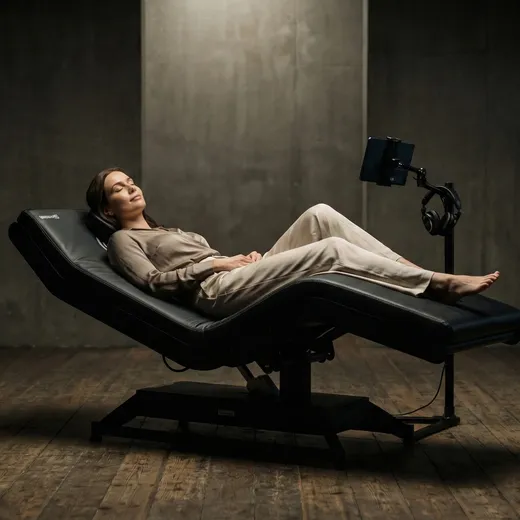
- The Satori RLX system delivers precise low-frequency vibrations (30–120 Hz) directly to the body. Research shows: vibroacoustic stimulation increases parasympathetic activity in all participants, measured via HRV parameters. Unlike self-directed exercises, VAT works independent of Your conscious participation — Your nervous system is addressed directly.
- Transcutaneous Vagus Nerve Stimulation (tVNS)
- Electrical stimulation of the auricular vagus branch at the ear. Non-invasive, painless, documented effects on the HPA axis and cortisol regulation.
The Vagus Nerve Therapy Lab combines both modalities in a structured protocol. Results are objectively documented through HRV monitoring.
| Phase | Intervention | Duration | Goal |
|---|---|---|---|
| Acute (Week 1–2) | VAT 2x/week + tVNS | 45 min/session | Parasympathetic baseline activation |
| Development (Week 3–6) | VAT 1x/week + home exercises | 45 min + daily 20 min | Transfer to daily life |
| Maintenance | Home protocol + monthly monitoring | Self-directed | Long-term stabilization |
The clinical phase creates the foundation. Self-directed exercises sustain the result. Both alone are suboptimal. The combination is the protocol.
What clients typically experience at NEST: after 2–4 VAT sessions, baseline RMSSD increases measurably. From this point forward, self-directed exercises work — Your nervous system is again in a state where it responds to training. Before this, the foundation was absent. It is comparable to physical therapy after an injury: first, acute inflammation must be addressed, then training can begin.
Vagus nerve exercises are not a trend. They are a clinically grounded method for improving autonomic regulation — when selected based on evidence and measured objectively. The difference between an exercise that feels good and an exercise that actually improves Your vagal tone appears in Your HRV measurement. The Autonomic Nervous System Reset retreat begins where Your self-directed exercises reach their limit.
Which pattern do you recognise?
Two short questions, three clear options. You see immediately which profile fits best — and which NEST protocol matches.
Which pattern do you recognise most strongly?
The next step, without searching.
Experiences that fit this
"Zoek je een traditionele wellness, dan moet je hier niet zijn. Dit is gezondheid next level."
"Echt een aanrader voor ondernemers of mensen die even tot rust willen komen en weer helemaal willen opladen."
"En die bedden... wauw! Zó comfortabel dat we er bijna niet meer uit wilden."
Want to know what this means for you?
One message is enough. We schedule a fifteen-minute intake, no obligation, and tell you honestly whether NEST fits your question.
Scientific References
"Resonant frequency breathing at approximately 6 breaths per minute significantly increases heart rate variability and vagal tone, with positive effects on mood and blood pressure."
"The diving reflex triggered by cold exposure to the face induces significant cardiac vagal activity, independent of breath-holding or body position."
"Vibroacoustic stimulation increases parasympathetic activity, measured via HRV parameters, in all participants."
"The Polyvagal Theory identifies a phylogenetically newer myelinated vagus that mediates social engagement and autonomic regulation through the ventral vagal system."