Marathon recovery: from muscle repair to the nervous system
Recovery after exertion is more than rest. What muscle repair, sleep and the nervous system decide after a hard session or a marathon — and how to measure recovery instead of guessing.
The hardest session does not make you stronger. The recovery after it does. That sounds like wordplay, but it is the core of all training theory: effort is the stimulus, recovery is the adaptation. Neglect recovery after exertion and you train hard yet fail to improve — sometimes you even regress.
This article describes what recovery really is, why the nervous system matters at least as much as the muscles, and how to measure recovery instead of guessing.
What recovery after exertion really is
During a hard effort you break down. Muscle fibres take on micro-damage, the glycogen store empties, and the body enters a catabolic, inflammatory state. That is not damage to avoid — it is the signal that triggers the adaptation.
The adaptation itself, supercompensation, happens in the hours and days after. The body recovers not just to the old level but builds a margin on top — provided it gets the time and the building blocks. Load again before that rebuild is finished, and the breakdown stacks up instead of the gain. That is the difference between progress and overtraining.
Muscle repair: the first 72 hours
The visible half of recovery plays out in the muscle. The micro-damage triggers an inflammatory response that clears and replaces the damaged tissue. That process explains the soreness that peaks around 24 to 72 hours after unaccustomed load — known as delayed onset muscle soreness, DOMS.
What supports this repair is well known and dull: enough protein for the rebuild, and above all sleep, in which the hormonal rebuilding takes place. No supplement or treatment replaces these two.
The nervous system: the invisible half
This is where most athletes go wrong. They judge recovery by the legs — if those feel good, the body is recovered. But the muscle is only half the story.
A hard effort also loads the autonomic nervous system: the sympathetic, activating part dominates, and the parasympathetic, restorative part is pushed back. Full recovery means that balance tipping back — the brake taking over from the throttle again. That process runs at its own pace, independent of the soreness. A body with loose legs but a still-exhausted autonomic system is not recovered; it is merely pain-free. We describe the mechanism behind it in HRV and the nervous system.
What speeds recovery — and what doesn’t
The hierarchy is clear, even if it is unspectacular:
- Sleep is the strongest recovery intervention there is. One bad night harms your recovery more than any supplement makes up for.
- Protein and energy supply the building blocks. Eating too little brakes recovery as hard as sleeping too little.
- Light active recovery — an easy walk, gentle cycling — keeps perfusion going without adding new load.
Everything beyond that is fine-tuning. Useful perhaps, but marginal as long as these three are not in order.
Oxygen and recovery: what HBOT adds
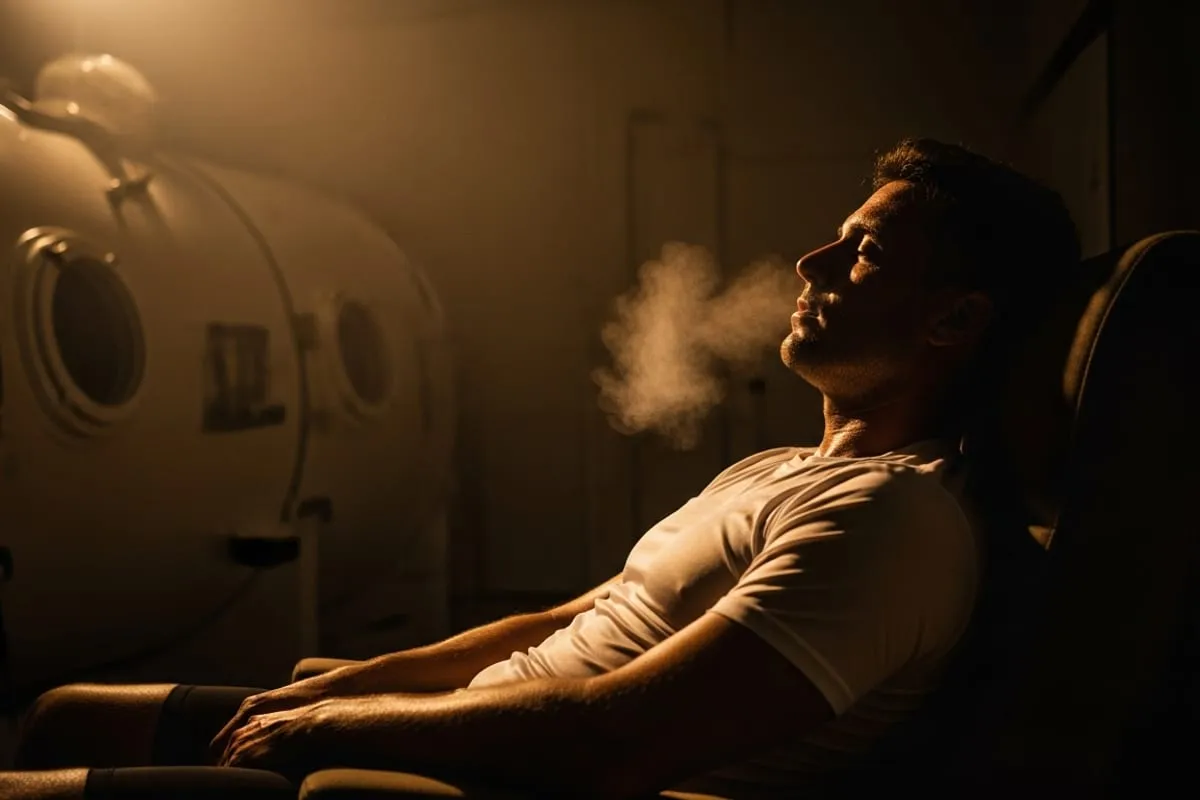
For those training at the edge of their recovery capacity — several hard loads a week, with too little time between — oxygen comes into play. Hyperbaric oxygen sharply raises the amount of dissolved oxygen in the blood, supporting energy production and the clearing of inflammatory products in the recovering tissue.
The evidence is young but growing. A systematic review found that hyperbaric oxygen can reduce exercise-induced muscle damage and soreness, and in well-trained athletes it is being studied as a recovery tool. We are honest about this: it is a complement, not a miracle, and it does not deserve to replace sleep and nutrition. We describe the full mechanism in our guide to hyperbaric oxygen therapy.
Measuring recovery instead of guessing
The problem with recovery is that it feels unreliable. The legs lie, the feeling lies, the motivation lies hardest of all. That is why serious athletes work with an objective measure: heart rate variability, HRV. It shows whether the parasympathetic system has taken the helm back — whether you are ready for the next load, or not yet.
That is exactly where recovery moves from feeling to figure. You don’t have to guess whether you are recovered; you can measure it. And whoever measures their recovery trains not harder but smarter: loading when the body is ready, and recovering when it needs to. That is not a matter of discipline, but of data.
What if you don't need to train harder, but recover smarter?
You read that recovery feels unreliable — the legs lie, the feeling hardest of all. The only honest measure is a figure: your HRV, and what lies beneath it. The NEST audit maps your recovery and load-tolerance profile, so you load when the body is ready and recover when it needs to. Not a question of discipline; a question of data.
Measure your recovery capacityWhich pattern do you recognise?
Two short questions, three clear options. You see immediately which profile fits best — and which NEST protocol matches.
Which pattern do you recognise most strongly?
The next step, without searching.

Experiences that fit this
"Zoek je een traditionele wellness, dan moet je hier niet zijn. Dit is gezondheid next level."
"Echt een aanrader voor ondernemers of mensen die even tot rust willen komen en weer helemaal willen opladen."
"En die bedden... wauw! Zó comfortabel dat we er bijna niet meer uit wilden."
Want to know what this means for you?
One message is enough. We schedule a fifteen-minute intake, no obligation, and tell you honestly whether NEST fits your question.
Scientific References
"Hyperbaric oxygen therapy reduces exercise-induced muscle damage and soreness (systematic review)."
"Hyperbaric oxygen therapy is being studied as a recovery and performance tool in well-trained athletes (narrative review)."
"Heart rate variability (HRV) is a validated measure of autonomic recovery and training load in strength and endurance sport."