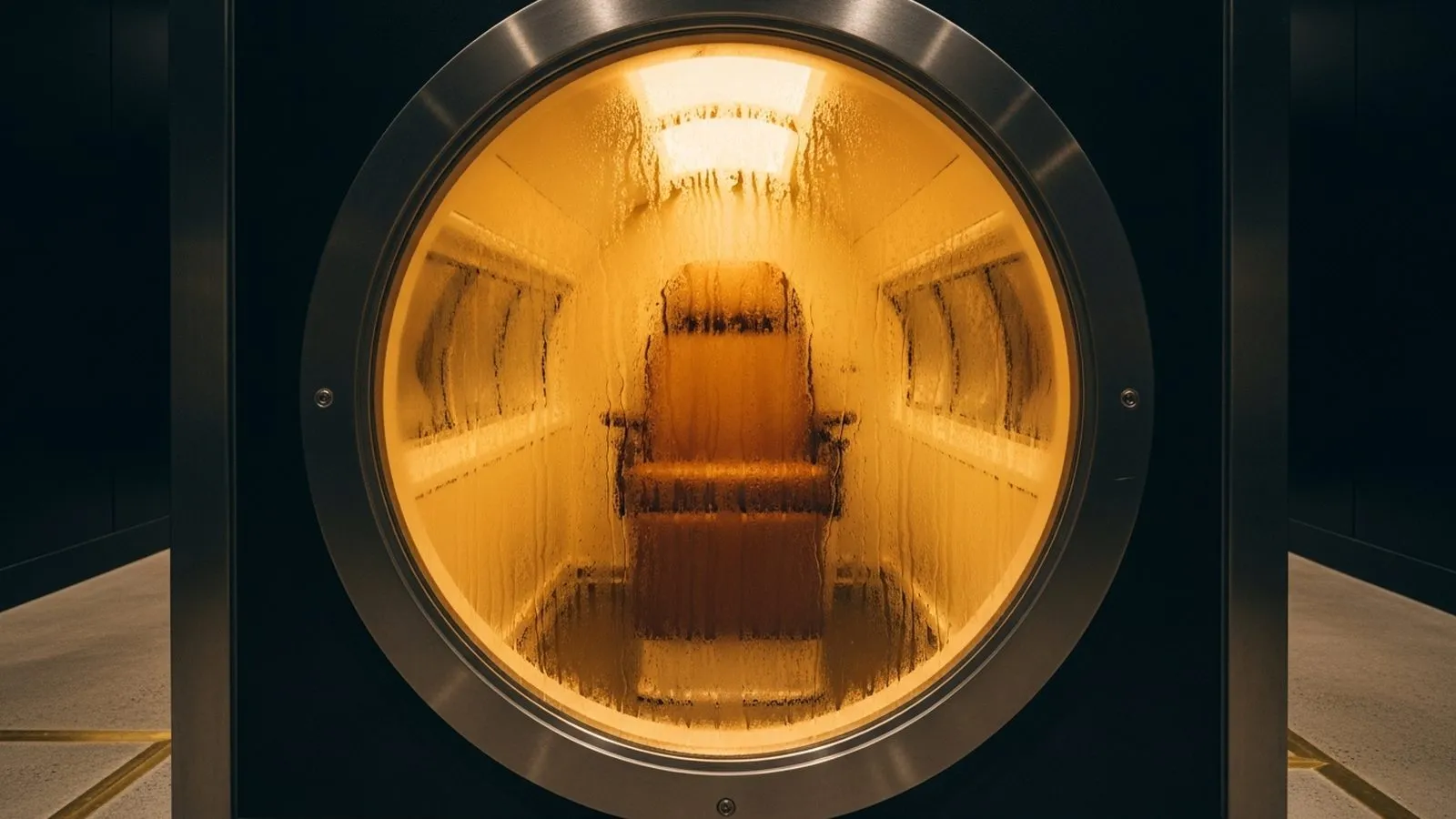
Hyperbaric sessions at NEST: what the chamber is and is not
What clinical hyperbaric oxygen therapy is under the ECHM definition, what the chamber at NEST does and does not do (roughly 95% oxygen from a concentrator), and why that difference matters.
Hyperbaric oxygen therapy is a precision intervention. A sealed pressure chamber in which medical oxygen is administered at elevated pressure, under continuous medical monitoring, following a standardised protocol. What happens inside that chamber is not a subtle addition to rest — it is a measurable shift in how oxygen behaves in your blood. This article describes the mechanisms, the monitoring, the breathing-gas system, and the environment in which NEST delivers this intervention.
The physics of clinical hyperbaric oxygen therapy
The mechanism rests on a single physical law: Henry’s Law. The quantity of a gas that dissolves in a liquid is directly proportional to the pressure of that gas above the liquid. Applied to the human body, this means that the increase in oxygen dissolved in blood plasma — independent of haemoglobin — is a direct consequence of the chosen pressure and oxygen concentration.
At NEST, the hard-shell chamber operates at 2.0 to 2.4 ATA. The oxygen comes from a concentrator and sits at roughly 95%, not 100% — we name that difference explicitly, because the published dose calculations below assume 100%. At 2.0 ATA on 100% oxygen, arterial oxygen partial pressure reaches approximately 1400 mmHg, compared with around 100 mmHg during normal breathing at sea level; at roughly 95% the actual value in our chamber is correspondingly lower. Gill and Bell documented in their review of hyperbaric oxygen dose that this pO₂ rises linearly with ambient pressure, and that specific therapeutic thresholds exist below which certain biological cascades simply do not initiate. The choice of 2.0 ATA is therefore not arbitrary: it is the pressure at which the literature reports consistent effects on angiogenesis, stem-cell mobilisation, and neuroplastic recovery mechanisms, without the elevated risk profile encountered at 2.5–3.0 ATA.
The BIBS system: pure oxygen delivery
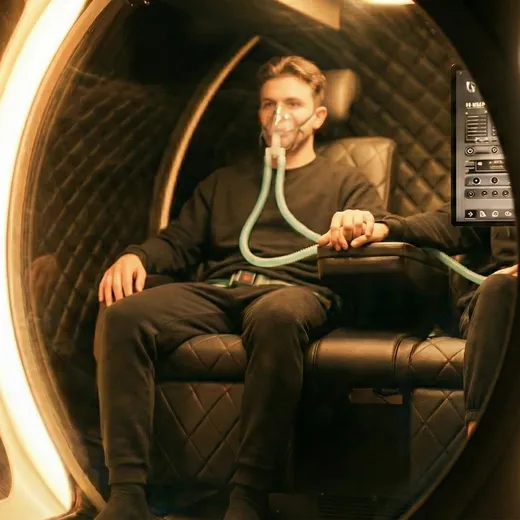
The Built-In Breathing System (BIBS) is the respiratory-gas system inside the chamber. A mask or hood — connected to a separate gas line — delivers the oxygen directly to the client, distinct from the chamber gas itself. The chamber compartment remains on ordinary air. Three functional consequences:
- Purity. The client breathes the oxygen without dilution by chamber air. The source is a concentrator at roughly 95%; the clinical evidence protocols in the literature use 100%. The exact FiO₂ is being verified against supplier documentation and is stated here as approx. 95% until then.
- Fire safety. By keeping the chamber compartment on air, oxygen enrichment of the environment is prevented. This is a requirement for CE-marked medical hyperbaric systems.
- Air breaks. The protocol provides for scheduled periods during which the client briefly breathes chamber air. These pauses minimise the risk of central nervous system oxygen toxicity during longer protocols.
BIBS is not a comfort feature. It is the condition under which clinical HBOT can be delivered safely and reproducibly.
Continuous monitoring during HBOT treatment
A session at NEST is an attended, monitored procedure — not a medical treatment. Each phase — compression, time at pressure, decompression — follows pre-defined curves.
- Video monitoring. A medical-grade camera inside the chamber provides continuous imagery to the operator. The client is in view at every moment.
- Two-way intercom. Clear audio link between chamber and operator. The client may communicate at any time.
- Vital signs. Heart rhythm, respiratory rate, and peripheral oxygen saturation are read out continuously. Deviations trigger immediate protocol intervention.
- Emergency protocols. Rapid decompression procedures, fire-suppression systems, and procedures for medical incidents are pre-defined and periodically rehearsed.
- Personnel. Sessions are run by a chamber operator at the console, who manages pressure, gas switching and intercom contact. No physician is attached to NEST at present. No unattended use, no automated sessions without oversight.
This is a medical device, not an accessory. The monitoring is the reason the biological effects described above occur reproducibly without exposing the client to avoidable risk.
The experience: sixty minutes inside the chamber
Each session lasts sixty minutes of effective time at pressure, preceded by a controlled compression phase and followed by gradual decompression. The client is seated in an adjustable chair upholstered in Maybach leather. Comfort here is not an aesthetic choice but a physiological instrument: a body that is not in sympathetic alarm extracts oxygen more efficiently from plasma. Parasympathetic dominance increases tissue uptake of the hyperoxic substrate.
The lighting is dimmed. The compression curve is slow and predictable. The intercom remains within reach. Hadanny and colleagues conducted a randomised controlled trial of 60 sessions at 2.0 ATA and documented significant improvements in attention, information-processing speed, and executive function, confirmed by functional MRI showing increased cerebral blood flow. The session frame — duration, pressure, environment — is therefore not interchangeable; it is precisely the configuration within which those results were obtained.
NEST as a clinical environment
The facility is located in De Deelen, Friesland. Not a hospital context, not a resort. Clinical precision embedded in an environment that generates no superfluous sympathetic input: laminar airflow, circadian-governed lighting, EMF-conditioned rooms. Efrati and Ben-Jacob, in their review of the neuroplastic mechanisms of HBOT, described how the response is pressure-dependent and how the broader physiological frame around the session co-determines the extent to which angiogenesis, stem-cell proliferation, and axonal regeneration come to expression. The environment is part of the protocol — not décor.
HBOT within the wider NEST protocol
Clinical HBOT is not offered at NEST as an isolated intervention. Sessions are integrated into a stacked protocol that — depending on the clinical objective — is combined with clinical photobiomodulation, vagus nerve stimulation, and contrast therapy. HBOT supplies the substrate (oxygen). PBM activates the enzyme (cytochrome c oxidase) that processes this substrate within the mitochondrial respiratory chain. Vagal activation raises parasympathetic tone, and with it tissue extraction. The hyperbaric oxygen chamber functions at NEST as one component within a composite whole.
Key message
Clinical hyperbaric oxygen therapy is a medical procedure with a measurable physical basis, a monitored protocol, and a structured delivery pathway via BIBS. At NEST, every parameter — pressure, oxygen purity, monitoring, comfort, environment — is a functional element of the protocol. The physics is clear. The monitoring is continuous. The environment is purposeful.
Which pattern do you recognise?
Two short questions, three clear options. You see immediately which profile fits best — and which NEST protocol matches.
Which pattern do you recognise most strongly?
The next step, without searching.
Experiences that fit this
"Ruim vier jaar post-covid en na tweeënhalve week zuurstofkamer al verbetering."
"Echt een aanrader voor ondernemers of mensen die even tot rust willen komen en weer helemaal willen opladen."
"Veertig sessies van negentig minuten in acht weken, met HRV, slaapscores en een wandeltest ernaast. Voor onze dochter is het verschil voelbaar."
Want to know what this means for you?
One message is enough. We schedule a fifteen-minute intake, no obligation, and tell you honestly whether NEST fits your question.
Scientific References
"Arterial oxygen partial pressure rises linearly with ambient pressure, with 2.0 ATA at 100% oxygen reaching a pO₂ of approximately 1400 mmHg compared to 100 mmHg during normal breathing."
"Hyperbaric oxygen therapy at 2.0 ATA induces significant improvements in cognitive function, cerebral blood flow, and brain metabolism in an aging population."
"The neuroplastic effects of HBOT — including angiogenesis, stem cell proliferation, and axonal regeneration — are pressure-dependent and require supraphysiological oxygen concentrations that are only achieved at clinical pressures."