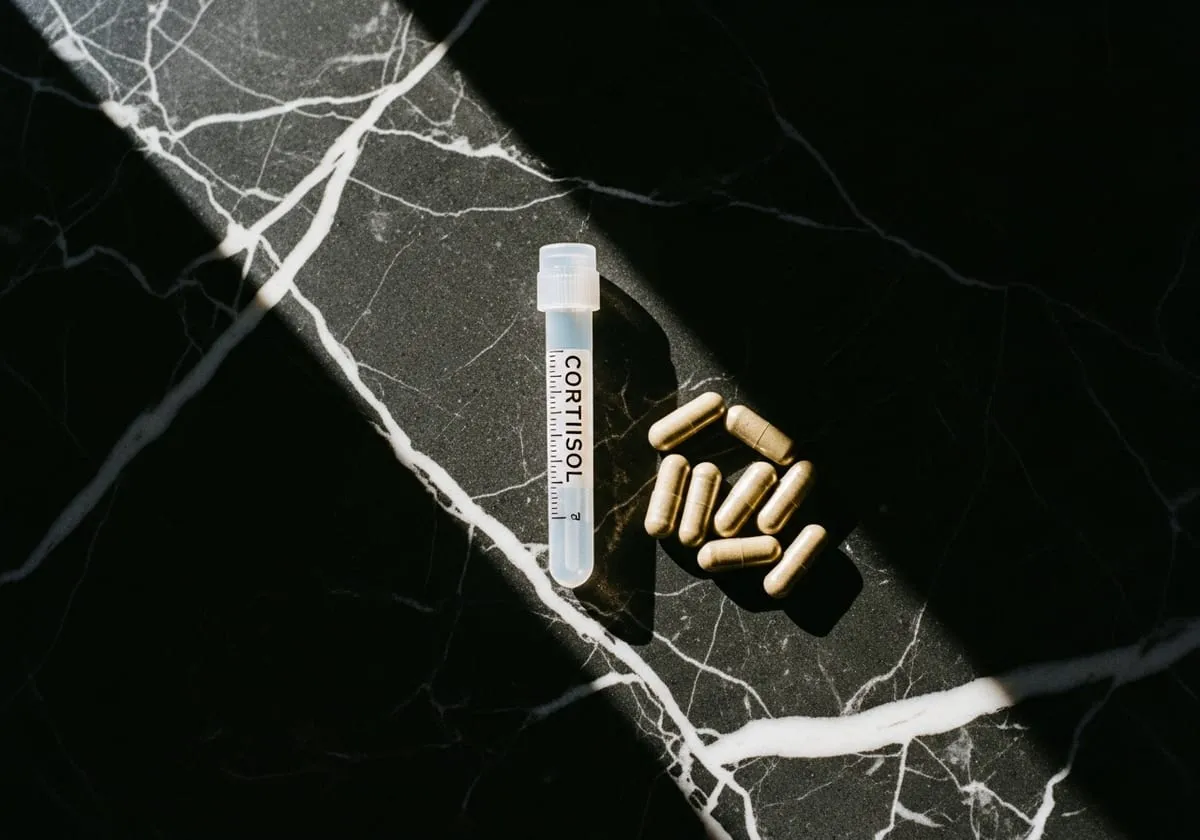
Elevated Cortisol: Why Supplements Don't Work and What Actually Does
Elevated cortisol isn't a supplement deficiency. It's HPA axis dysregulation. This protocol addresses the cause via HBOT, photobiomodulation, and vagal stimulation.
You sleep six hours, wake with a heart rate of 82, and by 10:00 AM already feel the tension of a day that hasn’t begun. Your doctor says: stress. The internet says: ashwagandha. But elevated cortisol isn’t a supplement deficiency. It’s the measurable consequence of an HPA axis that no longer regulates correctly—and no capsule in the world repairs a feedback loop that’s been overloaded for months or years.
How Elevated Cortisol Damages Your Body
The executive who feels tension on Sunday evening for Monday’s work. The entrepreneur who wakes at 03:00 with a brain that won’t stop. The professional who’s exhausted by day three after two weeks of vacation. These aren’t character traits. These are symptoms of chronic elevated cortisol—and they follow a predictable pattern.
Cortisol isn’t the enemy. It’s the primary glucocorticoid hormone that mobilizes your body for action: blood sugar rises through gluconeogenesis, attention sharpens via noradrenergic activation, immune function is temporarily suppressed in favor of acute survival. In a functional system, this response lasts 20–60 minutes. Then cortisol shuts itself off through negative feedback on the hypothalamus.
The problem emerges when this system stops turning off. During chronic psychosocial stress—the constant pressure of responsibility, decisions, deadlines without closure—your HPA axis stays activated. Not in acute spikes, but at an elevated baseline level that persists 24 hours a day. Weeks become months. Damage accumulates.
With chronic elevated cortisol, you see the following clinical picture:
- Disrupted sleep architecture—the characteristic 03:00 awakening is an aberrant cortisol spike that fractures REM sleep
- Visceral fat storage around the abdomen, regardless of caloric intake, through cortisol-driven lipogenesis
- Cognitive sluggishness despite mental hyperactivity—your prefrontal cortex functions suboptimally while your amygdala remains overactive
- An immune system that oscillates between overreaction (chronic inflammation) and suppression (elevated infection susceptibility)
- Reduced insulin sensitivity from sustained gluconeogenesis
This isn’t a vague pattern of complaints. This is measurable physiological damage that progressively worsens as long as your HPA axis goes unaddressed. Elevated cortisol experiences present differently for every professional, but the underlying mechanism is identical.
Testing Cortisol: The Circadian Profile
Most doctors measure cortisol via a single 08:00 blood sample. That’s insufficient. Cortisol follows a circadian rhythm: high upon waking (the cortisol awakening response, CAR), gradually declining through the day, lowest around midnight. A single measurement tells you nothing about the system’s dynamics.
- 4-Point Salivary Test
- Four saliva samples at fixed times: waking, +30 minutes, midday, evening. This produces a cortisol curve that makes circadian regulation visible. The 2016 Stalder consensus confirmed that the CAR is a reliable biomarker for HPA axis activity when the protocol is followed precisely.
- Cortisol Awakening Response (CAR)
- The rise in cortisol within 30–45 minutes of waking. A blunted CAR indicates HPA axis exhaustion. An exaggerated CAR suggests hyperactivation. Both patterns are clinically significant and require different intervention strategies.
- Evening Cortisol
- Cortisol that doesn't fall to baseline in the evening is one of the most consistent markers of chronic stress dysregulation. It explains why you feel "wired" at 23:00 despite physical exhaustion.
The difference between measuring cortisol via blood test and a circadian profile is the difference between a photograph and a film. The photo shows a moment. The film shows the system.
At NEST, every cortisol-related program begins with this circadian profile. Without this data, every intervention is guesswork. With this data, the protocol is precisely calibrated to your specific dysregulation pattern—hyperactivation requires a different approach than exhaustion.
HPA Axis Dysregulation: The Mechanism Behind Chronic Elevated Cortisol
The hypothalamic-pituitary-adrenal axis (HPA axis) is the central control system for cortisol stress response. The mechanism works as follows: the hypothalamus detects a stressor and produces CRH (corticotropin-releasing hormone). The pituitary gland responds with ACTH (adrenocorticotropic hormone). The adrenal glands produce cortisol. Cortisol then inhibits, through negative feedback, the hypothalamus and pituitary—the system shuts itself down.
During chronic stress, this feedback loop fails. The glucocorticoid receptors in the hypothalamus and hippocampus become less sensitive—comparable to insulin resistance. The signal is there, but the response doesn’t occur. The result: your HPA axis continues producing cortisol without adequate inhibition.
Dedovic and Engert demonstrated that both clinical and non-clinical burnout are associated with a blunted cortisol awakening response. This seems paradoxical—burnout with low cortisol—but it’s the logical end stage of chronic overload: the axis can no longer respond adequately. First hyperactivation, then exhaustion, then dysregulation.
This explains why elevated cortisol experiences are so variable. In the early phase, you feel hyperalert, anxious, tense—your sympathetic nervous system is constantly activated. In the late phase, you feel numb, flat, exhausted—the axis has crashed. Both are cortisol problems. But the mechanism—and therefore the intervention—differs fundamentally.
The early phase requires down-regulation: your sympathetic nervous system must be dampened. The late phase requires reconstruction: your HPA axis must be reset so the feedback loop functions again. A protocol that doesn’t distinguish between these, is by definition suboptimal.
Why Supplements and Lifestyle Tips Fall Short
The internet is full of lists: ashwagandha, magnesium, yoga, breathing exercises, less coffee. These interventions aren’t wrong. They’re insufficient.
Ashwagandha modulates cortisol levels through adaptogenic action on glucocorticoid receptors—that’s documented in multiple meta-analyses. Magnesium supports GABAergic neurotransmission that helps regulate your HPA axis and plays a role in over 300 enzymatic processes. Resonance breathing (5.5 breaths per minute) increases vagal tone and acutely lowers cortisol. Cold water on the face activates the diving reflex and stimulates the vagus nerve.
But all these interventions operate at the symptom level. They dampen the signal. They don’t repair the system. They’re comparable to painkillers for a fracture: they reduce the complaint, but they don’t set the bone.
When your HPA axis has been dysregulated for months or years, when your glucocorticoid receptors have lost their sensitivity, when your circadian rhythm is structurally disrupted—then lowering cortisol with supplements is like mopping with the tap running. The water must be addressed at the source.
This is the distinction no lifestyle article makes: there’s a threshold below which self-regulation no longer suffices. That threshold is measurable via HRV (heart rate variability), your cortisol profile, and CAR. Below that threshold, clinical intervention isn’t a luxury—it’s a physiological necessity.
The NEST Cortisol Protocol: Clinical Down-Regulation
The NEST protocol for chronic elevated cortisol follows three phases, each addressing a different level of the problem.
| Phase | Intervention | Mechanism | Duration |
|---|---|---|---|
| 1 | Vagal stimulation (VAT) | Activates the parasympathetic branch, suppresses sympathetic hyperactivation, modulates HPA axis via afferent vagal fibers | Week 1–4 |
| 2 | Hyperbaric oxygen therapy (HBOT, 2.0 ATA) | Increases oxygen perfusion in the prefrontal cortex and hippocampus, restores neuroplasticity, facilitates BDNF expression | Week 2–8 |
| 3 | Photobiomodulation (PBM, 660/850nm) | Activates cytochrome c oxidase, increases mitochondrial ATP, reduces oxidative stress in adrenal cells | Week 1–8 |
Transcutaneous vagus nerve stimulation suppresses stress-induced cortisol release—this was recently confirmed in research showing that tVNS directly modulates the HPA axis response. The systematic review of HBOT in stress-related conditions documents improved symptomatology through neuroplastic mechanisms.
Each phase is monitored via objective biomarkers: HRV (RMSSD), your cortisol profile, and subjective questionnaires. The protocol is adjusted weekly based on this data. No fixed timeline—your physiology determines the pace.
This protocol isn’t a replacement for lifestyle modifications. It’s the physiological foundation that makes lifestyle modifications effective again. First repair the system, then maintain the system. Ashwagandha and magnesium become part of the maintenance phase—not the recovery phase.
Cortisol and Sleep: Circadian Reconstruction
Cortisol sleep disruptions follow a specific pattern. Cortisol normally falls after 21:00 to a nadir around midnight, then melatonin directs sleep architecture. With HPA axis dysregulation, cortisol remains elevated in the evening. The result: delayed sleep onset, reduced slow-wave sleep, and the characteristic 03:00 awakening—the moment when an aberrant cortisol spike fractures your sleep.
Circadian reconstruction doesn’t begin with melatonin supplements. Those address the symptom. Reconstruction begins with restoring your HPA axis regulation so cortisol once again falls correctly in the evening hours.
The NEST circadian protocol combines three elements:
| Time | Intervention | Goal |
|---|---|---|
| Morning (06:00–08:00) | Bright light exposure 10,000 lux | Normalize cortisol awakening response |
| Midday (12:00–14:00) | PBM session (660/850nm) | Support mitochondrial energy production |
| Late afternoon (16:00–18:00) | Vagal stimulation | Activate parasympathetic system for evening cortisol decline |
| Evening (20:00+) | Amber light protocol | Facilitate melatonin production |
This integrated protocol restores the circadian architecture from within. It’s not a series of disconnected tips—it’s an integrated system where each element reinforces the next.
This is the difference between symptom management and system restoration. Supplements and sleep rituals dampen the signal. HPA axis intervention repairs the system that produces the signal.
When your cortisol sleep pattern is normalized—measured via evening cortisol level in your saliva profile—more than just sleep quality improves. Cognitive function recovers. Emotional reactivity declines. Your prefrontal cortex regains control over your amygdala. This isn’t subjective experience. This is measurable neurobiological reconstruction.
Elevated cortisol isn’t a diagnosis. It’s a signal—a measurable signal that your HPA axis no longer functions adequately. The question isn’t whether you should lower cortisol. The question is whether your system can still regulate itself. The answer is in your cortisol profile. The Burnout and Neuro Recovery retreat begins where your self-regulation ends.
Which pattern do you recognise?
Two short questions, three clear options. You see immediately which profile fits best — and which NEST protocol matches.
Which pattern do you recognise most strongly?
The next step, without searching.
Experiences that fit this
"Zoek je een traditionele wellness, dan moet je hier niet zijn. Dit is gezondheid next level."
"Echt een aanrader voor ondernemers of mensen die even tot rust willen komen en weer helemaal willen opladen."
"En die bedden... wauw! Zó comfortabel dat we er bijna niet meer uit wilden."
Want to know what this means for you?
One message is enough. We schedule a fifteen-minute intake, no obligation, and tell you honestly whether NEST fits your question.
Scientific References
"Both clinical and non-clinical burnout are associated with a blunted cortisol awakening response, indicating HPA axis dysregulation."
"The cortisol awakening response is a reliable biomarker for HPA axis activity when measured according to standardized protocol with precise timing."
"Hyperbaric oxygen therapy induces neuroplasticity and improves symptoms in stress-related conditions via increased oxygen perfusion and BDNF expression."
"Transcutaneous auricular vagus nerve stimulation suppresses stress-induced cortisol release and modulates the HPA axis response."