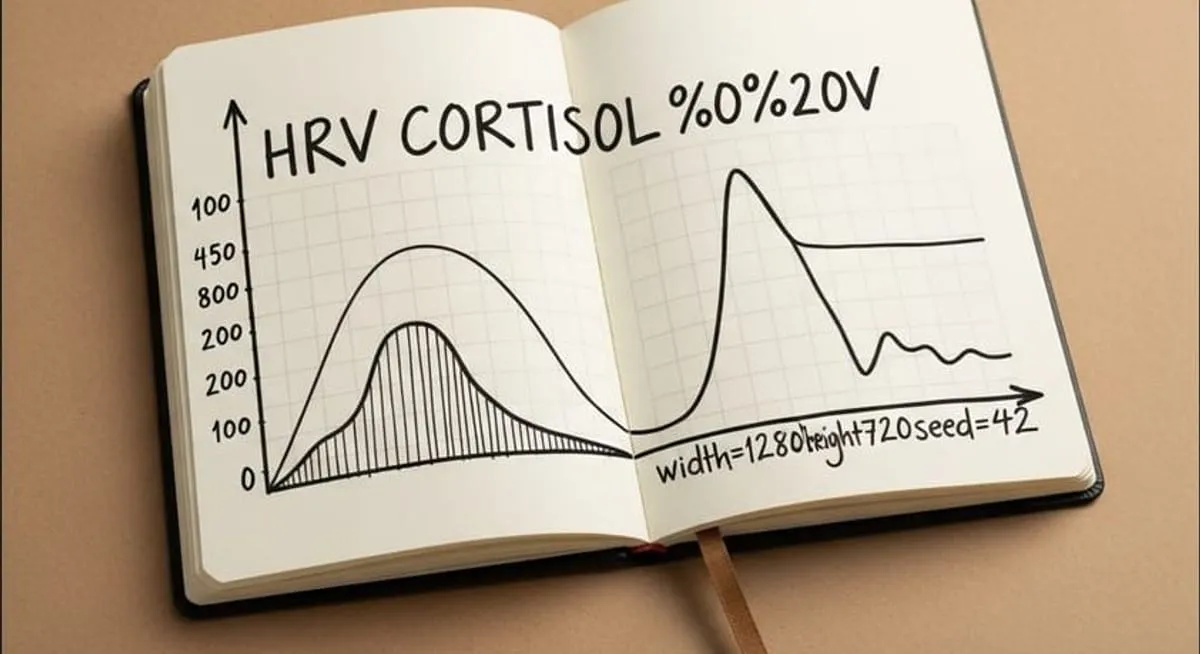
Early Burnout Signs: What Wired-but-Tired Actually Means Physiologically
Early burnout signs are not personality quirks. Three axes destabilise in parallel — cortisol curve, HRV, sleep architecture. What objective measurement reveals before the system tips.
You are looking up early burnout signs. Not because you are curious, but because you suspect the answer applies to you. This article sets out what is happening physiologically in this phase, which three axes destabilise, which interventions actually work and which do not, and when early signs have already crossed into clinical burnout. Not as coaching, but as clinical reading.
The phase between healthy stress and full burnout has different names in different traditions — overspannen in Dutch clinical practice, Überlastung in German, “stress-related exhaustion” in UK occupational medicine, “wired but tired” in the wellness vernacular. The biology is the same. It is the last window in which the neurobiological system can return to baseline without prolonged residualisation. What you do or fail to do in that window determines whether you function again in six weeks or rebuild from the floor in twelve months. The window does not open or close on how you feel; it opens or closes along measurable biological parameters. The intervention that works targets those parameters, not atmosphere.
Early burnout versus clinical burnout — where the line really sits
UK and continental European clinical guidelines treat burnout as a stress-related disorder rather than a stand-alone psychiatric diagnosis. Practically, the distinction between early signs and clinical burnout follows three criteria. One: at least three tension-related symptoms (exhaustion, sleep disturbance, irritability, concentration loss, somatic complaints). Two: significant functional impairment, professional or social. Three: duration shorter than six months for early-stage; longer for established burnout.
That is clinically useful but not a biological line. What sits under that line is a continuum of the same dysregulation in increasing degree. The HPA axis begins to flatten its stress response — first hyperactive, then paradoxically low. Autonomic balance shifts into sympathetic dominance — lower HRV, higher resting heart rate, reduced vagal tone. Sleep architecture fragments — less deep sleep, REM shift or REM fragmentation, early waking. In the early phase these shifts are measurable but partially reversible. By full burnout they consolidate into a new set point from which the system does not climb back unassisted.
The hard practical implication: the difference between resolving early burnout and living through full burnout is not in how much you rest. It is in what you actively restore during the window. Three weeks of holiday does something for the average early-burnout patient — but without targeted axis-by-axis restoration, the window often closes before the workload resumes. The picture returns, heavier. That is not bad luck; it is physiology without intervention.
For the wider phasing — early, mid, residualisation — the structural reading is the tri-phasic recovery model. For the time question framed objectively: how long burnout recovery takes.
The three axes — cortisol, HRV, sleep architecture
People in early burnout have four words for what is happening. Biology has three: HPA axis, autonomic balance, sleep architecture. Together they decide whether the system is still inside the recovery envelope.
Axis one — the cortisol curve
Cortisol is not a single stress hormone. It is a daily curve: a sharp morning rise (Cortisol Awakening Response, CAR) within thirty minutes of waking, then a gradual decline through the day, a low evening value, a nadir around midnight. The curve drives energy availability, immune modulation, glucose metabolism and the sleep-wake cycle.
In early burnout we typically see: a morning rise that is flattened rather than sharp — you do not wake up, you peel yourself off the pillow. Evening values that are elevated — you are more alert at night than rest permits. With further dysregulation the entire curve inverts: low morning, flat day, evening spike. This is the flattening associated with allostatic load. By full burnout the inversion is consolidated.
Measurement requires four saliva strips at defined times across a single day — no invasive procedure. The result tells you whether your mornings need active stimulation or dampening, and whether evening descent requires light discipline or pharmacological support.
Axis two — heart rate variability
HRV is not a smartwatch number. It is the time variation between consecutive heartbeats — a direct mirror of the balance between sympathetic (accelerator) and parasympathetic (brake). High HRV means a flexible autonomic system; low HRV means a system locked in sympathetic dominance. In clinical burnout, HRV is significantly reduced relative to healthy controls, and the reduction is measurable already at the early stage (PMID: 27535344). Research on burnout patients shows both reduced parasympathetic activity and blunted HPA-axis responsiveness simultaneously — the axes couple (PMID: 26557670).
Practical reading: HRV below your own baseline across three to four consecutive weeks, combined with other markers, means the autonomic system no longer flips back into parasympathetic dominance during rest. Sleep stops producing recovery. Sitting still stops producing rest. The metric is not what you feel; it is what the heart rhythm shows.
The structural article on the autonomic nervous system and HRV sits alongside this one.
Axis three — sleep architecture
Sleep is not a block. It is a sequence: light sleep, deep sleep (NREM-3, slow-wave), REM sleep, light sleep, in roughly ninety-minute cycles. Deep sleep does the heavy work — glymphatic clearance, growth hormone release, procedural memory consolidation. REM does the emotional work — affect regulation, declarative memory, cognitive processing.
In early burnout we see three patterns: less deep sleep (especially in the first cycle), REM shift to later in the night or REM fragmentation, and early waking around three to four in the morning — usually cortisol-driven. Subjectively: you sleep six hours and feel depleted; your partner says you did sleep. Both are true. You slept — but it was not restorative sleep. That three-in-the-morning pattern is examined in detail in waking up at 3 a.m..
The coupling of the three axes
What makes these three axes determinative is that they reinforce each other. A flattened cortisol curve weakens morning activation and disrupts circadian steering of sleep architecture. Disrupted deep sleep weakens the parasympathetic offline reset at night, which lowers HRV further. Lower HRV baseline means the sympathetic system releases less easily during the day, which drives evening cortisol up and re-enters the loop. This is not a psychological spiral — it is a physiological round-trip.
The practical consequence: you cannot repair one axis and expect the others to follow. Sleep hygiene without HRV work improves subjective experience without tipping the system. HRV training without cortisol correction produces short-term gains overrun by the evening spike. Cortisol correction without sleep-architecture protocol leaves mornings empty because the deep-sleep layer is missing. The system must be addressed on all three axes simultaneously.
What works, what does not — four intervention categories assessed soberly
The advice landscape around early burnout is overcrowded. Apply three tests per intervention: does it work mechanistically (can it restore the three axes), is it measurable (can you see it working), is it scalable in your reality (does it fit your week without becoming its own stressor)? Through that filter, not much survives.
Category one — behaviour and environment. What works: strict sleep discipline (fixed times, dark and cool bedroom, no screens late), morning light discipline (ten to thirty minutes of direct daylight in the first hour), caffeine cutoff before midday, alcohol elimination during the recovery window, structured breathwork (4-7-8, heart-coherence pacing, physiological sigh) two to three times daily. These are not tips; they are hygiene. Without this layer everything else underperforms.
Category two — nutrition and supplementation. What works: stable blood sugar (three meals, protein at breakfast, restricted refined carbohydrates), magnesium glycinate in the evening (vagal support, sleep architecture), targeted vitamin correction based on lab values (D, B-complex, ferritin), omega-3. Detail on dose, timing and mechanism is in cortisol-lowering supplements.
Category three — psychology and cognition. What works: cognitive behavioural therapy targeting rumination and perfectionistic schemas, ACT (acceptance and commitment therapy) for occupational over-commitment, schema therapy for underlying patterns — see burnout recovery protocol.
Category four — physiological intervention. What works: targeted autonomic regulation via vagus-nerve stimulation, hyperbaric oxygen therapy at clinical specification for mitochondrial biogenesis and neuroinflammation, photobiomodulation (red light) for cytochrome-c oxidase activation. These interventions share one property: they are measurable, before and after, on biological parameters rather than feelings.
The filter is not “do you believe in it”. The filter is “can you measure the change”.
Escalation signals — when early burnout is already clinical
Some transitions are administrative (six months of symptoms = burnout). Some are physiological — more relevant to your situation. Five signals mark that the window is closing or has closed.
One — sleep no longer restores. Not difficulty falling asleep, but nine hours of sleep followed by broken waking. This indicates loss of sleep architecture: the deep-sleep layer is not doing its work. Subjective tracking says “I slept”; neuronal recovery did not happen.
Two — caffeine tips into panic rather than focus. Caffeine blocks adenosine and activates sympathetic tone — in healthy dysregulation this produces focus, in fixed dysregulation it tips into palpitations, panic, sometimes dissociation. The system has no room for additional sympathetic input.
Three — weekends feel like overtime. No recovery experience during free days. The parasympathetic dominance you should be experiencing — calm, with some appetite, slight rest inertia — does not arrive.
Four — cognitive overflow on simple tasks. Answering an email feels like a meeting. A meeting feels like a day. A day feels like a week. This is cognitive debt, measurable on reaction-time tests and EEG patterns.
Five — unexplained somatic complaints. Palpitations, tinnitus, headache patterns, gut symptoms that no specialist can explain. This is autonomic dysregulation surfacing in end organs.
Three or more of these simultaneously: you are probably past the early-burnout phase and in the mid-burnout transition. The intervention changes — what was manageable on an outpatient basis now usually requires a condensed clinical programme. The phasing detail is in burnout recovery stages.
The NEST approach — Vitaliteitsaudit, protocol, residualisation
NEST treats early burnout no differently from full burnout in protocol structure — but differently in intensity. The three non-negotiables are the same: objective diagnostics first, mechanism-based protocols, medical supervision.
Profiling. The NEST Neural Triage below on this page returns a first profile in two minutes — anonymous, no contact details required. Output: an indication of where you sit on the continuum between early overload and consolidated burnout.
Vitaliteitsaudit. The Vitaliteitsaudit (€495) measures the three axes objectively: 24-hour cortisol curve, diagnostic-grade HRV baseline, sleep architecture from tracking data, plus inflammatory markers, mitochondrial indicators via organic acids in urine, thyroid and sex-hormone panel, vitamin status. The output is not a list — it is a directional indication of which axis is the primary lever.
Intervention. At the early-burnout stage, an outpatient programme with targeted protocols is often sufficient. At more advanced dysregulation: the Burnout & Neuro Recovery Retreat — a 3 to 5-day condensed clinical trajectory with HBOT, photobiomodulation, autonomic regulation and medical supervision. Followed by eight to sixteen weeks of at-home protocol with follow-up consultations.
Residualisation. The piece a retreat without lab work does not deliver. Personalised supplementation based on organic-acid analysis, sleep-architecture protocol for home, HRV-tracking plan for the first twelve weeks, follow-up consultations at six and twelve weeks against baseline biomarkers. What is recovering and what is not becomes visible in numbers, not in feelings.
For UK-based clients, the journey from London or the Home Counties is comparable to internal UK private clinics in travel time, with the added benefit of premium privacy and a clinical positioning that combines biomarker rigour with frontier modalities. Concrete retreat budgets are set after the audit and intake; you pay for clinical precision rather than for accommodation.
Core message
You are seeing early burnout signs. That is a biological status, not a personality trait, not a work-tempo issue resolvable by discipline. The three axes destabilising — HPA axis, autonomic balance, sleep architecture — do not return to baseline through the availability of time. They return through targeted input.
What you can do now is concrete. It is not one thing. It is a measurement plus a protocol — both objectively calibrated to your own biology. The question of what to do about early burnout has a consistent answer across decades of stress physiology: know where you are first, then do exactly what that position requires. No pause in general terms. No intervention without calibration. The rest is hoping.
What the system needs is not reassurance — it is a reference point. That reference point is the Vitaliteitsaudit. What the system needs next is not a holiday — it is a protocol. That protocol is mechanism-targeted and measurable. What the system finally needs is not chance — it is residualisation. Twelve weeks of at-home protocol with follow-up consultations that lock the gain in place.
Your window is open. Not indefinitely.
Which pattern do you recognise?
Two short questions, three clear options. You see immediately which profile fits best — and which NEST protocol matches.
Which pattern do you recognise most strongly?
The next step, without searching.

Experiences that fit this
"Zoek je een traditionele wellness, dan moet je hier niet zijn. Dit is gezondheid next level."
"Echt een aanrader voor ondernemers of mensen die even tot rust willen komen en weer helemaal willen opladen."
"En die bedden... wauw! Zó comfortabel dat we er bijna niet meer uit wilden."
Want to know what this means for you?
One message is enough. We schedule a fifteen-minute intake, no obligation, and tell you honestly whether NEST fits your question.