
How long does burnout recovery take? The reality in numbers and biomarkers
Burnout recovery typically takes 6 to 18 months. The factors that accelerate it, delay it, and how to measure it objectively.
How long does burnout recovery take. The short answer: on average six to eighteen months, with significant individual variation. Cohort research shows that conservative treatment typically requires one to three years, while structured interventions with biomarker monitoring can substantially shorten this timeframe. The relevant question is not how much time passes, but which neurobiological parameters actually normalise.
Your recovery duration is determined by three factors: severity at onset, the presence of previous episodes, and the extent to which the intervention addresses the underlying dysregulation of the autonomic nervous system and the HPA-axis. Subjective energy is an unreliable indicator. Objective biomarkers — cortisol curve, HRV trend, sleep architecture — form the only solid basis for assessing progress.
The three phases of burnout recovery and their duration
Burnout recovery proceeds in three neurobiologically distinguishable phases. Each phase has its own characteristic duration, its own set of physiological processes, and its own markers that signal the transition to the next phase.
Acute phase (month 1-3). Dominant feature is exhaustion at the cellular level. Mitochondrial dysfunction, flattened cortisol curve and sympathetic hyperactivation dominate the picture. Functional work is not only impossible in this phase but counterproductive — any significant load delays the recovery process. Signal of transition to phase 2: return of a normal sleep-wake rhythm without pharmacological support.
Recovery phase (month 3-9). Mitochondrial capacity restores, the HPA-axis begins to recalibrate, parasympathetic activity increases. In this phase phased reintegration becomes possible, provided it is structured. Cognitive capacity recovers before physical endurance. Signal of transition to phase 3: HRV baseline remains stable under a working load of 16 to 20 hours per week.
Integration phase (month 6-18). Autonomic reintegration and consolidation of new stress-response thresholds. The system relearns how to switch efficiently between sympathetic activation and parasympathetic restoration. Full recovery means that your biological response to a working week no longer deviates from pre-burnout level. This phase is often underestimated — early return to full workload in month 6 is the most common cause of relapse.
Which factors determine the duration
Five variables account for most of the variation in recovery time.
Severity at start. Patients with a flattened cortisol awakening response of less than 30% and resting HRV below the tenth percentile have on average a two- to three-fold longer recovery duration than patients with milder dysregulation.
Previous episodes. A second burnout typically takes 1.5 times as long as the first. A third episode takes even longer and carries an increased risk of chronically persisting autonomic dysregulation.
Age. Above 45 years, mitochondrial recovery proceeds more slowly. Women in the perimenopausal phase experience additional complication from concurrent hormonal recalibration.
Comorbidity. Subclinical hypothyroidism, vitamin D deficiency, iron deficiency and chronic sleep fragmentation extend recovery duration by thirty to sixty percent if untreated.
Type of intervention. A conservative approach (rest, talk therapy) achieves recovery in one to three years. Interventions that directly act on mitochondrial capacity and autonomic regulation accelerate this to six to twelve months.
What accelerates recovery according to research
Four interventions show measurable acceleration of the recovery curve in clinical research.
Sleep regulation. Consolidation of sleep architecture is the first intervention with measurable effect. Restoration of deep-sleep percentage above 18% of total sleep time correlates strongly with cortisol normalisation. Morning light therapy (10,000 lux for 20 minutes) and elimination of blue light exposure after 21:00 are fundamental.
HRV tracking. Daily HRV measurement functions as objective compass. Research confirms HRV as a reliable marker for autonomic dysregulation in burnout. A rising ten-week average HRV trend predicts recovery substantially more reliably than subjective feeling.
Structured reintegration. Phased build-up — starting at 4 hours per week and increasing by a maximum of 2 hours per week as long as HRV baseline remains stable — reduces relapse risk by more than fifty percent compared with unstructured return.
Clinical interventions. Hyperbaric oxygen therapy and photobiomodulation directly support mitochondrial recovery. For comprehensive protocols we refer to Schema Recovery Burnout and the three phases of neurobiological recovery.
What delays recovery
Premature return to work. The dominant cause of protracted recovery. Returning to work based on subjective feeling — before objective biomarker normalisation — leads to relapse within six months in more than forty percent of cases.
Persisting stressors. Unchanged workload, unhealthy relational dynamics or financial pressure render recovery structurally impossible. No biological intervention can compensate for continuing exposure to the original pathogenic context.
Untreated comorbidity. Subclinical thyroid dysfunction, ferritin below 50 µg/l, vitamin D below 75 nmol/l and obstructive sleep apnoea are the four most common hidden delayers. Without targeted screening these typically remain undetected.
How to measure recovery objectively
Subjective feeling is not a reliable measure. Three biomarkers together yield a valid picture of actual progress.
Salivary cortisol curve. Four measurements spread across the day (waking, +30 min, midday, evening) reveal whether the HPA-axis is restoring. A healthy curve shows a morning peak of 200 to 400% above evening level.
Heart rate variability. Daily morning measurement (RMSSD or pNN50) on waking, trended over four weeks. A rising ten-week average indicates parasympathetic restoration.
Sleep architecture. Continuous measurement via a clinical-grade sleep monitor reveals deep-sleep percentage and sleep efficiency. Deep sleep above 18% and efficiency above 88% mark a recovering system.
For clinically controlled recovery with integrated biomarker monitoring, the Burnout Neuro Recovery retreat offers a structured protocol. For accelerated mitochondrial support, hyperbaric oxygen therapy is an evidence-based intervention.
Next step
Recovery from burnout is not a question of time, but of physiological change. The six to eighteen months are a statistical average — your individual trajectory is determined by what you measure, what you intervene with, and how consistently you do both. Subjectively feeling better is a first signal, not an endpoint. Genuine recovery shows itself in the numbers.
Which pattern do you recognise?
Two short questions, three clear options. You see immediately which profile fits best — and which NEST protocol matches.
Which pattern do you recognise most strongly?
The next step, without searching.
Experiences that fit this
"Zoek je een traditionele wellness, dan moet je hier niet zijn. Dit is gezondheid next level."
"Echt een aanrader voor ondernemers of mensen die even tot rust willen komen en weer helemaal willen opladen."
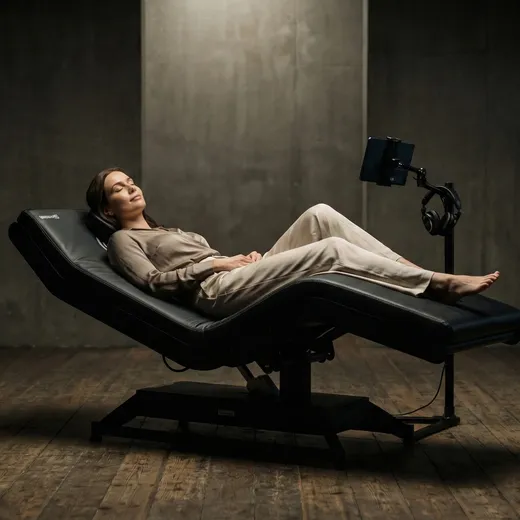
"En die bedden... wauw! Zó comfortabel dat we er bijna niet meer uit wilden."
Want to know what this means for you?
One message is enough. We schedule a fifteen-minute intake, no obligation, and tell you honestly whether NEST fits your question.
Scientific References
"Longitudinal research on recovery from Exhaustion Disorder shows that persistent self-reported stressors slow the recovery process and partly explain why full recovery can take months to years."
"Heart rate variability is a validated objective indicator of psychological stress and autonomic load, useful for monitoring work-related exhaustion."