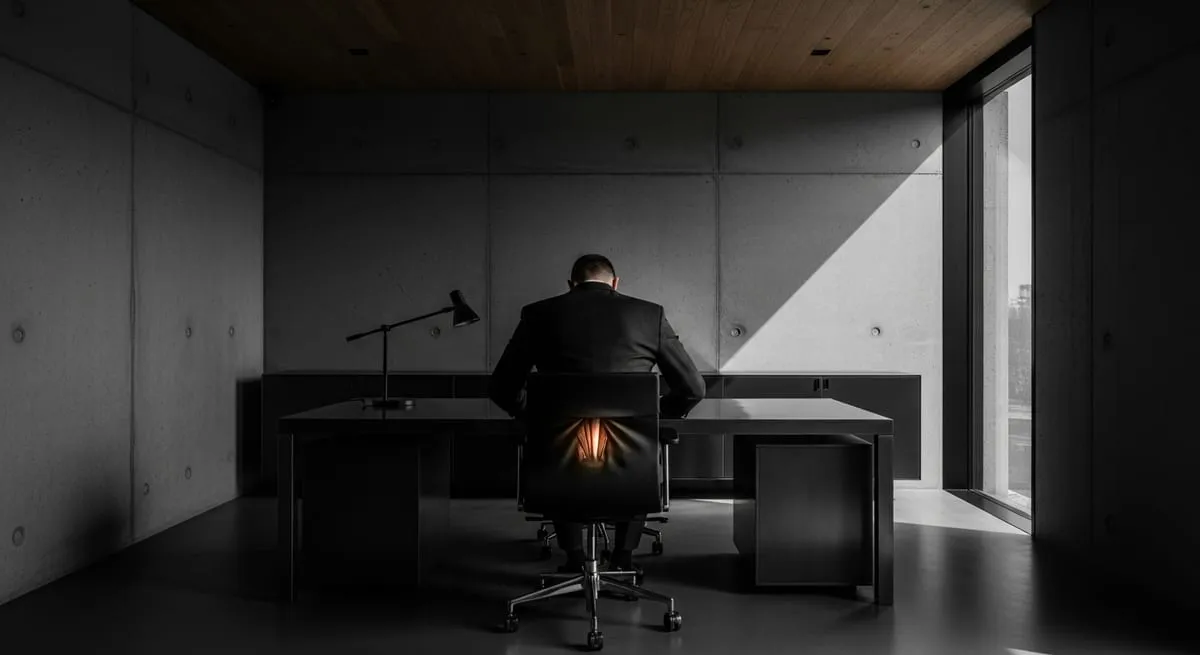
Back pain from sitting: the executive problem no break resolves
Back pain from sitting is not a matter of the wrong chair. What hours of sitting do to the lower back, and why standing up alone does not remove the cause.
The chair is comfortable, the desk setup ergonomic, and still, at the end of the day, that nagging line sits in your lower back. Back pain from sitting is the occupational hazard of anyone who does their work largely behind a screen. The reflex is a better chair or a standing desk. Those help, but they do not remove the cause — because the problem does not sit in the chair, it sits in what eight hours of stillness do to the lower back.
What hours of sitting do to your back
Sitting looks like rest, but for the spine it is load. In a seated posture the natural lordosis of the lower back flattens and the pelvis tilts backward. The pressure shifts onto the intervertebral discs. Static sitting raises the pressure on the lumbar disc, which can lead to dehydration and a decrease in disc height.
At the same time something happens to the muscles. The deep stabilisers of the back sit under a constant, low-level load during prolonged sitting — not the short, powerful contraction they are built for, but an endless holding. That leads to fatigue, reduced circulation and, over time, a muscle that no longer does its job well. The back that did “nothing” all day is in truth exhausted.
Why standing up and moving is not enough
The standard advice is correct: stand up every hour, change posture, take a walk. Movement interrupts the static load and is indispensable. But there is a limit to what this resolves.
Once the deep stabilising muscle, the multifidus, is weakened in its drive, that drive does not recover on its own with a few breaks. An activation deficit of the multifidus is a demonstrated underlying mechanism behind the recurrence of low back complaints. You can stand up more often and still end every evening with the same back, because the underlying weakening persists. Breaks relieve the symptom of the moment; they do not restore the stability.
The executive problem
For those who lead, negotiate and decide, the working day is rarely flexible. The calendar dictates the posture, not the other way around. Physiotherapy three times a week does not fit a schedule that is already overfull, and the back pays the price of years in which the body was subordinate to output.
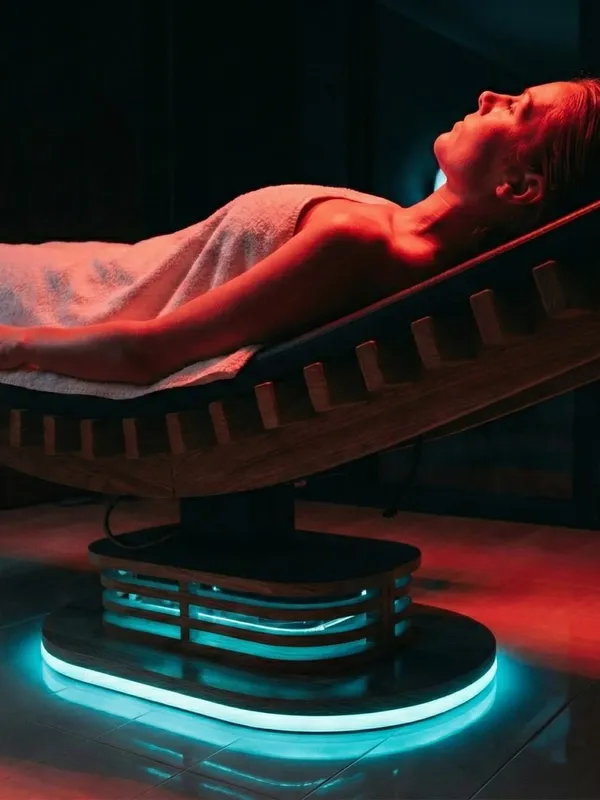
This is not a call for more rest — rest is precisely what the seated back already gets too much of. It is a matter of bringing back the stabilising layer without it costing, again, time you do not have. The ReLounge back therapy is built for that: a training that equals hours of core stability, but lying down, in thirty minutes, while the drive of the deep back muscles is restored through electrical stimulation.
Restoring the drive instead of working around it
The difference from a better chair is fundamental. A chair lowers the load; it does not restore the muscle. Exercise trains the muscles that still obey; it often does not reach the switched-off deep muscle. Research shows that electrical stimulation reactivates the motor units of that muscle where exercise alone does not — the muscle is forced to contract along a route that bypasses the blocked drive.
For the seated professional this means: not redesigning the working day, but enabling the back to carry that working day again. The ReLounge intervenes at the cause — the disrupted drive — and not at the symptoms a cushion or a break temporarily dampens.
Back pain from sitting does not disappear with a better chair or an extra walk, however sensible those are. The cause is a lower back whose deep stabilisers are weakened by hours of stillness and no longer driven correctly. Standing up interrupts the load; it does not restore the drive. That restoration is where the ReLounge back therapy begins — built for those who cannot rewrite their calendar, but do want their back back.
The next step, without searching.
Experiences that fit this
"Echt een aanrader voor ondernemers of mensen die even tot rust willen komen en weer helemaal willen opladen."
"Ondanks mijn zware werkweekend ga ik hier uitgerust vandaan."
"Een wereld waarbij de tijd stilstaat en er tegelijkertijd de mogelijkheid is om kennis te maken met technologie die zijn tijd ver vooruit is."
Want to know what this means for you?
One message is enough. We schedule a fifteen-minute intake, no obligation, and tell you honestly whether NEST fits your question.
Scientific References
"Static sitting raises the pressure on the lumbar intervertebral disc, which can lead to dehydration and a decrease in disc height."
"An activation deficit of the deep stabilising back muscle (multifidus) is an underlying mechanism behind the recurrence of low back pain."
"Movement exercises improve complaints but leave multifidus activation unchanged; electrical stimulation reactivates the muscle's motor units where exercise alone does not."