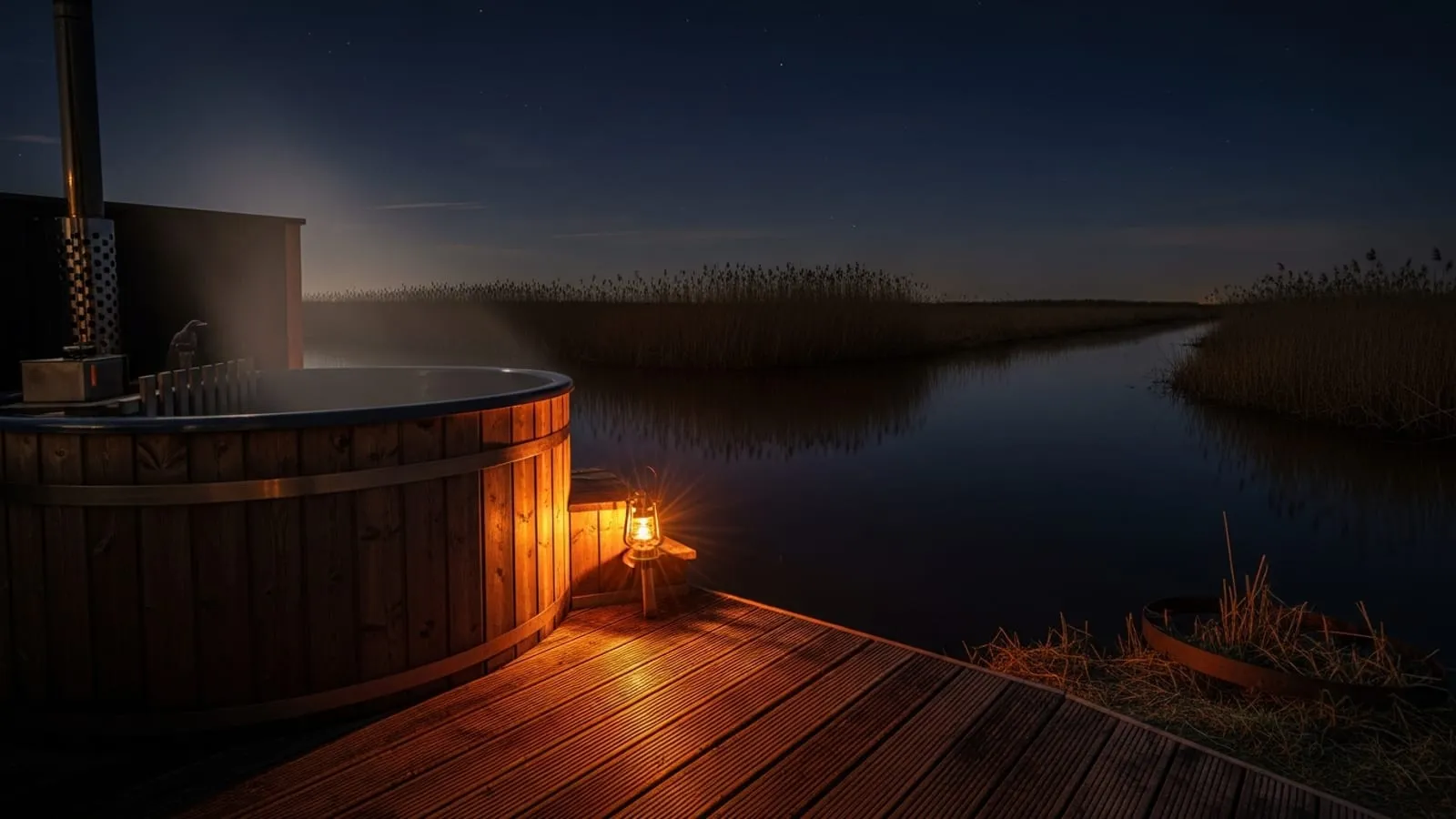
Private Spa Hotel: Why Being Alone Is What Makes the Difference
A private spa hotel isn't about luxury but about absence: no strangers, no queue, no shared silence. What that actually changes about an overnight stay.
A private spa hotel is almost always sold on luxury: the bigger bath, the costlier finish, the more elaborate package. But that is not where the private lies. The real difference is an absence — no strangers, no queue, no silence that is never quite silent. And it is precisely that absence which lets a stay work.
This is not a list of the prettiest places. It is an explanation of why so many people who once visited a large spa complex then deliberately search for private — and what exactly they were missing.
Private sauna with an overnight stay: what “private” really means
A private sauna with an overnight stay is not a sauna that happens to sit somewhat out of the way. It means the sauna, the bath and the space around them are yours alone for the duration of your stay. No one else has access. There are no opening hours to keep to, and no stranger opening the door just as you’d settled into the calm.
That sounds like a detail. It is the opposite. In a shared complex the crowd sets the rhythm: you wait for the steam room, you share the temperature with whoever happens to be there, you unconsciously make allowances for others. A private sauna hands you back control — over the temperature, the time, the pace. You do nothing because you must, and nothing because someone else is waiting.
Why shared rest is not rest
There is a contradiction in a busy spa complex that is rarely named: you come to let go, yet share the space with hundreds who came for the same thing. The body does not fully relax in the presence of strangers — part of the attention stays, unconsciously, turned outward.
A systematic review of regular sauna bathing describes the relaxation of heat as a reliable effect. But that effect only unfolds once vigilance falls away, and vigilance does not fall away among strangers. A private spa hotel removes the one variable that structurally stands in the way of relaxation: the presence of an audience.
The night is the real difference
A day visit ends before the evening falls. A private spa stay runs on into the night — and that is where most arrangements either squander or earn the difference.
Because the calm of a sauna is brief; the calm of a good night carries on. And a good night demands something a complex rarely offers: genuine silence and genuine darkness. Environmental noise measurably disturbs sleep architecture, even at levels that don’t wake you. A stay with thin walls, corridor traffic and a car park beneath it does not deliver that silence. A freestanding private suite in an empty landscape does. You don’t hear the difference — you notice it the next morning, in how you wake.
A private spa break: where it is genuinely scarce
Searching for a private spa break turns up plenty, but most of it is private in name, not in fact: a lockable cabin inside a larger complex, or a hotel room with a spa floor below that you share with the whole storey.
Genuinely private — your own, freestanding space with no shared walls, in surroundings with no other guests — is rarer than the search results suggest. It takes room, and room is exactly what the densely populated regions don’t have. The north does. NEST sits at the edge of De Deelen, in the open Frisian landscape, where private doesn’t mean one locked door but a whole stay with no one else nearby.
Just the two of you, no one else
The most common reason for a private spa break is going away together. A private sauna with an overnight stay for two isn’t about the facilities but about what isn’t there: no phone looking over your shoulder, no calendar, no strangers, no reason to hold back.
Two people, your own sauna, your own outdoor bath under a dark sky, and no one else. That is something fundamentally different from a romantic package in a crowded complex — even with the same equipment on paper. The difference lies not in what is there, but in who is not.
Where the silence leads
A private spa break is, for most people, a well-earned pause, and that is enough. But there is a form of private stay in which the silence is not merely pleasant but does something — in which you leave not just relaxed, but with something that still carries you the weeks after.
That is the difference between relaxing and recovering. NEST is not a spa complex with a private option; it is a private stay in the Frisian landscape where calm is the starting point and recovery is the aim. If you’d like to see what that looks like, read on about the NEST sanctuary.
The question is not whether private is nicer than shared. It is. The question is whether you take the silence home for one night — or for longer.
What if being alone isn't the goal, but the start?
You chose a private spa break because you wanted no one around. Rightly so — only without an audience do you truly let go. But in the Frisian landscape that seclusion isn't an endpoint: it's the condition under which recovery begins. You leave not just rested, but with something that stays. See what that stay looks like.
Discover the NEST sanctuaryWhich pattern do you recognise?
Two short questions, three clear options. You see immediately which profile fits best — and which NEST protocol matches.
Which pattern do you recognise most strongly?
The next step, without searching.
Experiences that fit this
"Allerlei wellness faciliteiten om 'de accu op te laden' in en om het nest."
"Echt een aanrader voor ondernemers of mensen die even tot rust willen komen en weer helemaal willen opladen."
"En die bedden... wauw! Zó comfortabel dat we er bijna niet meer uit wilden."
Want to know what this means for you?
One message is enough. We schedule a fifteen-minute intake, no obligation, and tell you honestly whether NEST fits your question.
Scientific References
"A systematic review of regular sauna bathing describes consistent effects on relaxation and wellbeing, independent of its thermal action on the heart and blood vessels."
"Environmental noise measurably disturbs sleep architecture, even at levels that do not wake the sleeper — making a quiet environment a direct prerequisite for restorative sleep."