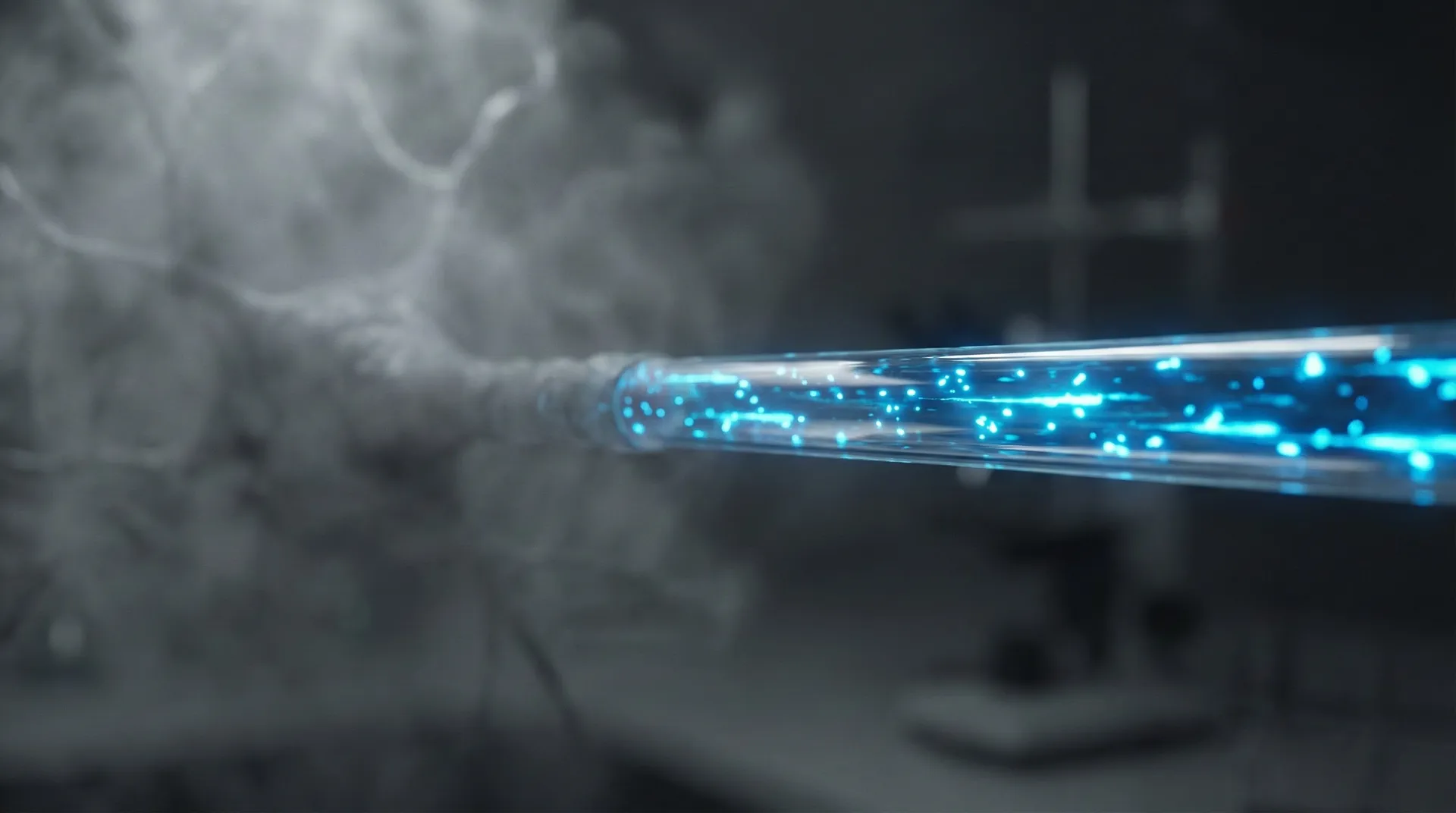
Resolving Brain Fog: The Bio-Energetic Leak
Brain fog is not fatigue, but an energy transport problem in your neurons. How creatine functions as a 'shuttle' for mental clarity.
- Brain fog is often a failure of 'Spatial Buffering': energy does not arrive at the synapse in time.
- ATP is a slow molecule; Creatine is the rapid courier that transports energy through long nerve fibres.
- Bio-energetic recovery is the first step in addressing mental flatness and burnout symptoms.
You recognise the feeling: you are in a meeting and your brain feels like a browser with too many open tabs. The ‘loading wheel’ keeps spinning. You can process the information, but the speed is gone. You search for words, your motivation is flat and a permanent fog hangs over your thoughts.
The medical world often vaguely labels this “stress” or “early burnout”. At NEST we look deeper, at the cell biology. Brain fog is in many cases not a psychological problem, but a logistics problem in your nerve cells.
The Diagnosis: Stagnating Spatial Buffering
Brain fog is the subjective feeling of delayed synaptic transmission, often caused by mitochondrial inefficiency.
Neurons are the longest cells in your body. The energy factories (mitochondria) are often located in the cell nucleus, but the energy is needed at the far end: the synapse, where neurotransmitters fire. When the transport of energy between nucleus and synapse falters, ‘noise’ arises on the line. Your signal weakens.
The Science: The Creatine ‘Shuttle’ System
1. The Transport Problem
The primary fuel of your cells is ATP. However, this is a large, heavy and unstable molecule. It moves slowly through the long extensions (axons) of your nerves. With intensive thinking, the demand at the end is greater than the supply from the nucleus. The consequence: synaptic failure. You lose the thread.
2. The Solution: Spatial Buffering
This is where creatine is irreplaceable. Together with phosphate it forms Phosphocreatine (PCr). This molecule is smaller and moves many times faster through the cell fluid than ATP.
The mechanism is called Spatial Buffering:
- Creatine picks up energy at the mitochondria.
- It ‘shuttles’ rapidly through the axon to the synapse.
- There it immediately releases energy for firing a thought.
Without sufficient creatine in your system, this ‘high-speed line’ falls silent and you are dependent on the slow local-train transport of ATP.
3. The Link with Depressive Feelings
There is a direct correlation between bio-energetics and mood. A brain with an energy deficit goes into ‘power-saving mode’. This manifests as listlessness, rigidity in thinking and despondency.
Research shows that increasing cerebral creatine can significantly accelerate the effectiveness of depression treatments. Energy is the prerequisite for neural rewiring (neuroplasticity).
The Intervention: The Recovery Plan
- Supplementation: The Creatine Protocol is the foundation to maximise brain stores.
- Light: Red light and near-infrared therapy (PBM) directly stimulate the mitochondria to produce more ATP.
- Vibration: Stress blocks recovery. We use Vibroacoustic Therapy (VAT) to bring the nervous system into a ‘ventral vagal state’ (safety).
Conclusion
You do not feel empty because you have ‘lost your passion’. You feel empty because your mitochondrial transport capacity is insufficient. Mental clarity is not a spiritual state, but a logistical result. Repair the supply lines, and the fog lifts.